Senate District 26
Registration: D 12176, R 11736, N 16360, total 40291, D +440
Incumbents: Merlin Bartz, R-Grafton and Mary Jo Wilhelm, D-Cresco
For
the second straight decade, redistricting has been unkind to Merlin
Bartz. He goes from having a comfortable Republican registration edge of
nearly 5000 to a district with a Democratic edge and a Democratic
incumbent.
Mary Jo Wilhelm knocked off two-term Republican Mark
Zieman in 2008; Zieman's dad had held the seat before him. The old
district had a break-even registration and was four whole counties:
Wilhelm's base of Howard (where she was a supervisor) plus Chickasaw,
Winneshiek and Allamakee. Wilhelm won by about 1000 votes and carried
all four counties. She keeps Howard, Chickasaw and a corner of
Winneshiek, but loses Decorah and most of the Winneshiek population.
(Decorah trended very blue that year.)
Bartz first went to the
Senate in 1992 after one House term, then won again in 1996 and 2000. He
used his free-ride year in 1998 to run for secretary of agriculture,
but in a bit of an upset lost the primary.
In 2001, Bartz got
paired up with Thurman Gaskill in the 2001 map, and resolved that
problem by resigning during the 2002 session to take a Bush 43
administration Department of Agriculture job. That let Gaskill, in an
even number district, hold over till 2004. When Gaskill retired in 2008,
Bartz moved right back in.
The new district partners didn't even border each other before; they were separated by Democrat Amanda Ragan.
The Bartz seat was his home county of Worth plus Winnebago, Hancock,
Franklin, and most of the land in Cerro Gordo; he had Clear Lake but
Ragan had Mason City. His 1990s district was Worth, all of Cerro Gordo,
and a corner of Mitchell.
Floyd and Mitchell Counties, and a piece
of eastern Cerro Gordo up to the limits of Mason City, come in from
Ragan's old seat. This turf is new to Wilhelm and mostly new to Bartz.
This is good news for Wilhelm (but bad news for Ragan.)
So Wilhelm
has the geographic advantage, and a voter registration edge too.
Indeed, it's better than her old district, which was break-even. Bartz
has also gotten involved in a tin-eared legal fight with his neighbors,
demanding that they pay half the cost of his livestock fence.
This
is the second of the two Senate districts that are split between
Congressional districts. (The other was Dennis Black's 15th district,
split between Loebsack and Boswell/Latham.) Here, House 51 goes east
into Braley's district, while House 52 is part of the east extension of
Steve King's.
July 19 Campaign Finance Report: Citizens For Good Government (Bartz committee), Wilhelm for Iowa Senate
Bartz has veen very active, raising $15,180.00 (almost all from
four-figure donors) and spending $16,731.47 during the period. He has
$16,111.18 on hand. Wilhelm raised almost as much -- $14,345 -- in a mix
of locals, PACs, Senate colleagues and a few heavy hitters. She spent
$2,929.75, giving her the cash on hand advantage at $19,594.59. And of course who knows how much outside cash will flow in.
House District 51
Registration: D 5675, R 6453, N 7732, total 19872, R +778
Incumbent: Josh Byrnes, R-Osage
Republicans
picked up this seat easily in 2010 when six term Democrat Mark Kuhn
stepped down. Josh Byrnes had easily won the a Republican primary and
beat Kurt Meyer, a losing candidate in the 2008 Democratic congressional
primary, by 2400 votes.
The district remains a swing seat but the
lines change a lot. Byrnes keeps only his home county of Mitchell,
which is about a third of a district. The new turf goes west to Worth
and east to Howard and a corner of Winneshiek. The three whole counties
are similar in size.
Manly Democrat -- that's his residence, not
an assessment of his machismo --Eric Hungerford is challenging here. (We
had a female candidate who was a Fertile Democrat a couple cycles ago.)
July 19 Campaign Finance Report: Byrnes for Statehouse, Friends of Eric S. Hungerford Byrnes had $5,728.81, Hungerford just $780.
House District 52
Registration: D 6501, R 5283, N 8628, total 20419, D +1218
Incumbent: Brian Quirk, D-New Hampton, no Republican candidate
Brian
Quirk is the sole survivor of the "Six Pack" of conservative Democratic
legislators who blocked key bills, including labor's must-pass list, in
the glory days of the Trifecta. They like it at home as he won by 900
votes in the tough 2010 cycle over Spillville mayor Michael Klimish,
who's running elsewhere this year.
This decade Quirk's district
moves west. Quirk keeps all of Chickasaw, but now Floyd County makes up
the largest piece of the district. Quirk also gets a strip of eastern
Cerro Gordo, 500 more Democrats, and no official Republican opposition. Independent opponent Craig Clark, former mayor of Rudd, lost to Josh Byrnes overwhelmingly (77-23%) in the 2010 GOP primary.
With Republicans nominating candidates at conventions literally from
the audience, it's interesting that they didn't just let Clark fill the
ballot line for them.
July 19 Campaign Finance Report: Brian Quirk for State Representative
Senate District 26, House District 51 & 52: District of the Day 1 - 5/30/2011 | District of the Day 2 - 3/16/2012

The worst.
Showing posts with label Brian Quirk. Show all posts
Showing posts with label Brian Quirk. Show all posts
Saturday, August 18, 2012

Friday, March 16, 2012
District Of The Day Reboot: Iowa Senate District 26, Iowa House District 51 & 52
Senate District 26
Registration: D 12961, R 11998, N 17803, total 42785, D +963
Incumbents: Merlin Bartz, R-Grafton and Mary Jo Wilhelm, D-Cresco
For the second straight decade, redistricting has been unkind to Merlin Bartz. He goes from having a comfortable Republican registration edge of nearly 5000 to a district with a Democratic edge and a Democratic incumbent.
Mary Jo Wilhelm knocked off two-term Republican Mark Zieman in 2008; Zieman's dad had held the seat before him. The old district had a break-even registration and was four whole counties: Wilhelm's base of Howard (where she was a supervisor) plus Chickasaw, Winneshiek and Allamakee. Wilhelm won by about 1000 votes and carried all four counties. She keeps Howard, Chickasaw and a corner of Winneshiek, but loses Decorah and most of the Winneshiek population. (Decorah trended very blue that year.)
Bartz first went to the Senate in 1992 after one House term, then won again in 1996 and 2000. He used his free-ride year in 1998 to run for secretary of agriculture, but in a bit of an upset lost the primary.
In 2001, Bartz got paired up with Thurman Gaskill in the 2001 map, and resolved that problem by resigning during the 2002 session to take a Bush 43 administration Department of Agriculture job. That let Gaskill, in an even number district, hold over till 2004. When Gaskill retired in 2008, Bartz moved right back in.
The new district partners didn't even border each other before; they were separated by Democrat Amanda Ragan. The Bartz seat was his home county of Worth plus Winnebago, Hancock, Franklin, and most of the land in Cerro Gordo; he had Clear Lake but Ragan had Mason City. His 1990s district was Worth, all of Cerro Gordo, and a corner of Mitchell.
Floyd and Mitchell Counties, and a piece of eastern Cerro Gordo up to the limits of Mason City, come in from Ragan's old seat. This turf is new to Wilhelm and mostly new to Bartz. This is good news for Wilhelm (but bad news for Ragan.)
So Wilhelm has the geographic advantage, and a voter registration edge too. Indeed, it's better than her old district, which was break-even. She also has more cash on hand; Wilhelm for Iowa Senate has $8,482.69 on the January 19 report, with $2,525 in loans out. "Citizens for Good Government" - Bartz's committee doesn't include his name, apparently -- had $4,511.83 on hand and $28,813.75 in outstanding bills.
Bartz has also gotten involved in a tin-eared legal fight with his neighbors, demanding that they pay half the cost of his livestock fence. Bleeding Heartland has a good overview.
This is the second of the two Senate districts that are split between Congressional districts. (The other was Dennis Black's 15th district, split between Loebsack and Boswell/Latham.) Here, House 51 goes east into Braley's district, while House 52 is part of the east extension of Steve King's.
House District 51
Registration: D 6038, R 6418, N 8407, total 20875, R +380
Incumbent: Josh Byrnes, R-Osage
Republicans picked up this seat easily in 2010 when six term Democrat Mark Kuhn stepped down. Josh Byrnes had easily won the a Republican primary and beat Kurt Meyer, a losing candidate in the 2008 Democratic congressional primary, by 2400 votes.
Manly Democrat -- that's his residence, not an assessment of his machismo --Eric Hungerford is challenging here. (We had a candidate who was a Fertile Democrat a couple cycles ago.)
The district remains a swing seat but the lines change a lot. Byrnes keeps only his home county of Mitchell, which is about a third of a district. The old turf, District 14, went south into Floyd, which was Kuhn's base and made up more than half of the district, and eastern Cerro Gordo. New district 51 goes west to Worth and east to Howard and a corner of Winneshiek. The three whole counties are similar in size.
Campaign finance reports: Byrnes for Statehouse
House District 52
Registration: D 6923, R 5580, N 9396, total 21910, D +1343
Incumbent: Brian Quirk, D-New Hampton
Brian Quirk is the sole survivor of the "Six Pack" of conservative Democratic legislators who stopped key bills, including labor's must-pass list, in 2009 and `10. Delores Mertz, faced with likely defeat after a 42 vote 2008 win, retired. The other four - Geri Huser, Larry Marek, McKinley Bailey and Doris Kelley - all lost.
Quirk was first elected in 2000. His district changed little in 2002; it was still his Chickasaw County base plus Howard and a piece of western Winneshiek. Under those lines he won by 900 votes in the tough 2010 cycle over Spillville mayor Michael Klimish, who's running elsewhere this year.
This decade Quirk's district moves west. Quirk keeps all of Chickasaw, but now Floyd County makes up the largest piece of the district. Quirk also gets a strip of eastern Cerro Gordo, 500 more Democrats, and no Republican opposition.
Campaign finance reports: Brian Quirk for State Representative
Original post 5/30/2011 Statewide Map: Front | Back (with City Insets) | Old Senate, House
Registration: D 12961, R 11998, N 17803, total 42785, D +963
Incumbents: Merlin Bartz, R-Grafton and Mary Jo Wilhelm, D-Cresco
For the second straight decade, redistricting has been unkind to Merlin Bartz. He goes from having a comfortable Republican registration edge of nearly 5000 to a district with a Democratic edge and a Democratic incumbent.
Mary Jo Wilhelm knocked off two-term Republican Mark Zieman in 2008; Zieman's dad had held the seat before him. The old district had a break-even registration and was four whole counties: Wilhelm's base of Howard (where she was a supervisor) plus Chickasaw, Winneshiek and Allamakee. Wilhelm won by about 1000 votes and carried all four counties. She keeps Howard, Chickasaw and a corner of Winneshiek, but loses Decorah and most of the Winneshiek population. (Decorah trended very blue that year.)
Bartz first went to the Senate in 1992 after one House term, then won again in 1996 and 2000. He used his free-ride year in 1998 to run for secretary of agriculture, but in a bit of an upset lost the primary.
In 2001, Bartz got paired up with Thurman Gaskill in the 2001 map, and resolved that problem by resigning during the 2002 session to take a Bush 43 administration Department of Agriculture job. That let Gaskill, in an even number district, hold over till 2004. When Gaskill retired in 2008, Bartz moved right back in.
The new district partners didn't even border each other before; they were separated by Democrat Amanda Ragan. The Bartz seat was his home county of Worth plus Winnebago, Hancock, Franklin, and most of the land in Cerro Gordo; he had Clear Lake but Ragan had Mason City. His 1990s district was Worth, all of Cerro Gordo, and a corner of Mitchell.
Floyd and Mitchell Counties, and a piece of eastern Cerro Gordo up to the limits of Mason City, come in from Ragan's old seat. This turf is new to Wilhelm and mostly new to Bartz. This is good news for Wilhelm (but bad news for Ragan.)
So Wilhelm has the geographic advantage, and a voter registration edge too. Indeed, it's better than her old district, which was break-even. She also has more cash on hand; Wilhelm for Iowa Senate has $8,482.69 on the January 19 report, with $2,525 in loans out. "Citizens for Good Government" - Bartz's committee doesn't include his name, apparently -- had $4,511.83 on hand and $28,813.75 in outstanding bills.
Bartz has also gotten involved in a tin-eared legal fight with his neighbors, demanding that they pay half the cost of his livestock fence. Bleeding Heartland has a good overview.
This is the second of the two Senate districts that are split between Congressional districts. (The other was Dennis Black's 15th district, split between Loebsack and Boswell/Latham.) Here, House 51 goes east into Braley's district, while House 52 is part of the east extension of Steve King's.
House District 51
Registration: D 6038, R 6418, N 8407, total 20875, R +380
Incumbent: Josh Byrnes, R-Osage
Republicans picked up this seat easily in 2010 when six term Democrat Mark Kuhn stepped down. Josh Byrnes had easily won the a Republican primary and beat Kurt Meyer, a losing candidate in the 2008 Democratic congressional primary, by 2400 votes.
Manly Democrat -- that's his residence, not an assessment of his machismo --Eric Hungerford is challenging here. (We had a candidate who was a Fertile Democrat a couple cycles ago.)
The district remains a swing seat but the lines change a lot. Byrnes keeps only his home county of Mitchell, which is about a third of a district. The old turf, District 14, went south into Floyd, which was Kuhn's base and made up more than half of the district, and eastern Cerro Gordo. New district 51 goes west to Worth and east to Howard and a corner of Winneshiek. The three whole counties are similar in size.
Campaign finance reports: Byrnes for Statehouse
House District 52
Registration: D 6923, R 5580, N 9396, total 21910, D +1343
Incumbent: Brian Quirk, D-New Hampton
Brian Quirk is the sole survivor of the "Six Pack" of conservative Democratic legislators who stopped key bills, including labor's must-pass list, in 2009 and `10. Delores Mertz, faced with likely defeat after a 42 vote 2008 win, retired. The other four - Geri Huser, Larry Marek, McKinley Bailey and Doris Kelley - all lost.
Quirk was first elected in 2000. His district changed little in 2002; it was still his Chickasaw County base plus Howard and a piece of western Winneshiek. Under those lines he won by 900 votes in the tough 2010 cycle over Spillville mayor Michael Klimish, who's running elsewhere this year.
This decade Quirk's district moves west. Quirk keeps all of Chickasaw, but now Floyd County makes up the largest piece of the district. Quirk also gets a strip of eastern Cerro Gordo, 500 more Democrats, and no Republican opposition.
Campaign finance reports: Brian Quirk for State Representative
Original post 5/30/2011 Statewide Map: Front | Back (with City Insets) | Old Senate, House
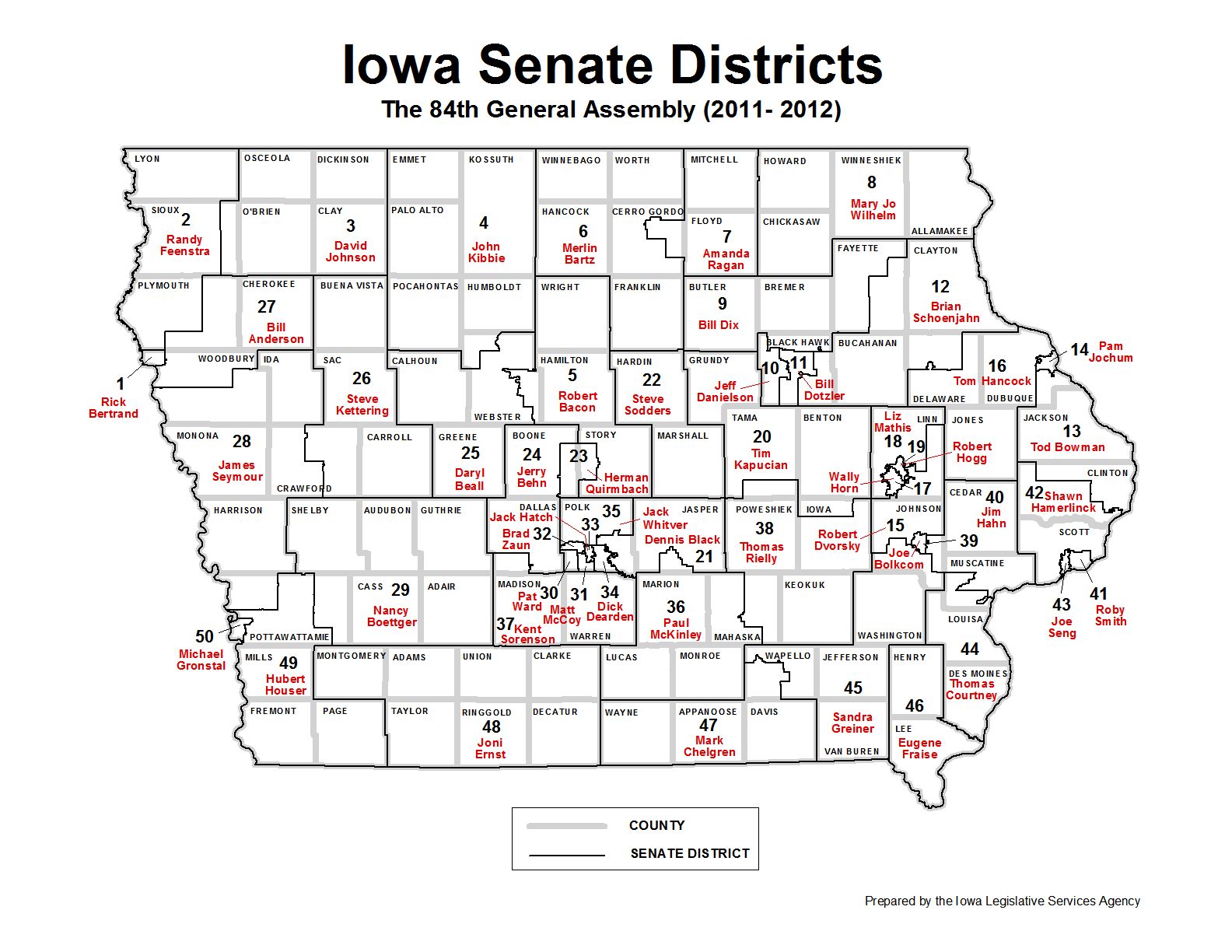
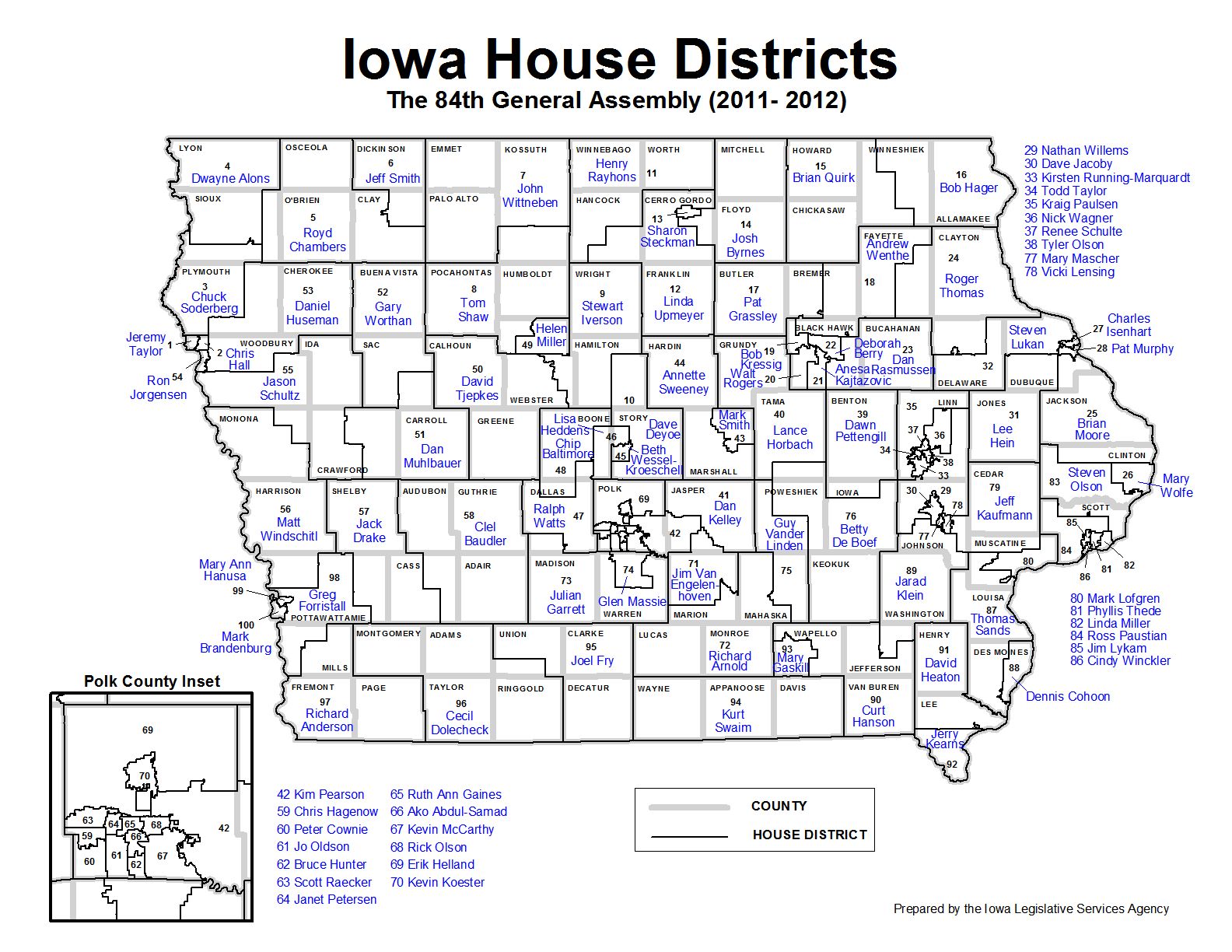
Monday, May 30, 2011
District of the Day: Senate District 26, House Districts 51 and 52
District of the Day: Senate District 26, House Districts 51 and 52

Senate District 26
Registration: D 12,775, R 11,468, N 16,544, total 40,804, D+ 1307
Incumbents: Merlin Bartz, R-Grafton and Mary Jo Wilhelm, D-Cresco
For the second straight decade, redistricting has been unkind to Merlin Bartz. He first went to the Senate in 1992 after one House term, then won again in 1996 and 2000. He used his free-ride year in 1998 to run for secretary of agriculture, but in a bit of an upset lost the primary.
In `01, Bartz got paired up with Thurman Gaskill in the 2001 map, and resolved that problem by resigning during the 2002 session to take a Bush 43 administration Department of Agriculture job. That let Gaskill, in an even number district, hold over till 2004. When Gaskill retired in 2008, Bartz moved right back in.
Bartz goes from having a comfortable Republican registration edge of nearly 5000 to a district with a Democratic edge and a Democratic incumbent.
Mary Jo Wilhelm knocked off two-term Republican Mark Zieman in 2008; Zieman's dad had held the seat before him. The old district had a break-even registration and was four whole counties: Wilhelm's base of Howard (where she was a supervisor) plus Chickasaw, Winneshiek and Alamakee. Wilhelm won by about 1000 votes and carried all four counties. She keeps Howard, Chickasaw and a corner of Winneshiek, but loses Decorah and most of the Winneshiek population. (Decorah trended very blue that year.)
The new district partners didn't even border each other before; they were separated by Democrat Amanda Ragan. The Bartz seat was his home county of Worth plus Winnebago, Hancock, Franklin, and most of the land in Cerro Gordo; he had Clear Lake but Ragan had Mason City. His 1990s district was Worth, all of Cerro Gordo, and a corner of Mitchell.
Floyd and Mitchell Counties, and a piece of eastern Cerro Gordo up to the limits of Mason City, come in from Ragan's old seat. This turf is new to Wilhelm and mostly new to Bartz. This is good news for Wilhelm (but bad news for Ragan; check back tomorrow.)
So Wilhelm has the geographic advantage, and a voter registration edge too, and has announced she'll run in this seat next year. Indeed, it's better than her old district, which was break-even. Bartz has nowhere else to go, though, and if Republicans are serious about taking control of the Senate this is a seat they'll need to target. With Jack Kibbie retiring and Pat Ward moving, this looks like the most likely two incumbent, Democrat vs. Republican Senate race in the state.
This is the second of the two Senate districts that are split between Congressional districts. (The other was Dennis Black's 15th district, split between Loebsack and Boswell/Latham.) Here, House 51 goes east into Braley's district, while House 52 is part of the east extension of Steve King's.
House District 51
Registration: D 5953, R 6206, N 7834, total 20000, R+ 253
Incumbent: Josh Byrnes, R-Osage
Republicans picked up this seat easily in 2010 when six term Democrat Mark Kuhn stepped down. Josh Byrnes had easily won the a Republican primary and beat Kurt Meyer, a losing candidate in the 2008 Democratic congressional primary, by 2400 votes.
The district remains a swing seat but the lines change a lot. Byrnes keeps only his home county of Mitchell, which is about a third of a district. The old turf, District 14, went south into Floyd, which was Kuhn's base and made up more than half of the district, and eastern Cerro Gordo. New district 51 goes west to Worth and east to Howard and a corner of Winneshiek. The three whole counties are similar in size.
House District 52
Registration: D 6822, R 5262, N 8710, total 20804, D+ 1560
Incumbent: Brian Quirk, D-New Hampton
Brian Quirk is the sole survivor of the "Six Pack" of conservative Democratic legislators who stopped key bills, including labor's must-pass list, in 2009 and `10. Delores Mertz, faced with likely defeat after a 42 vote 2008 win, retired. The other four - Geri Huser, Larry Marek, McKinley Bailey and Doris Kelley - all lost. Quirk has maintained that cautious conservaDem approach this session.
Quirk was first elected in 2000. His district changed little in 2002; it was still his Chickasaw County base plus Howard and a piece of western Winneshiek. Under those lines he won by 900 votes in the tough 2010 cycle.
This decade his district moves west. Quirk keeps all of Chickasaw, but now Floyd County makes up the largest piece of the district. Quirk also gets that small strip of eastern Cerro Gordo. The changes give Quirk 500 more Democrats, and 500 less excuses to ditch the party on key votes.
New Map | New Map (Insets) | Old Map
Senate District 26
Registration: D 12,775, R 11,468, N 16,544, total 40,804, D+ 1307
Incumbents: Merlin Bartz, R-Grafton and Mary Jo Wilhelm, D-Cresco
For the second straight decade, redistricting has been unkind to Merlin Bartz. He first went to the Senate in 1992 after one House term, then won again in 1996 and 2000. He used his free-ride year in 1998 to run for secretary of agriculture, but in a bit of an upset lost the primary.
In `01, Bartz got paired up with Thurman Gaskill in the 2001 map, and resolved that problem by resigning during the 2002 session to take a Bush 43 administration Department of Agriculture job. That let Gaskill, in an even number district, hold over till 2004. When Gaskill retired in 2008, Bartz moved right back in.
Bartz goes from having a comfortable Republican registration edge of nearly 5000 to a district with a Democratic edge and a Democratic incumbent.
Mary Jo Wilhelm knocked off two-term Republican Mark Zieman in 2008; Zieman's dad had held the seat before him. The old district had a break-even registration and was four whole counties: Wilhelm's base of Howard (where she was a supervisor) plus Chickasaw, Winneshiek and Alamakee. Wilhelm won by about 1000 votes and carried all four counties. She keeps Howard, Chickasaw and a corner of Winneshiek, but loses Decorah and most of the Winneshiek population. (Decorah trended very blue that year.)
The new district partners didn't even border each other before; they were separated by Democrat Amanda Ragan. The Bartz seat was his home county of Worth plus Winnebago, Hancock, Franklin, and most of the land in Cerro Gordo; he had Clear Lake but Ragan had Mason City. His 1990s district was Worth, all of Cerro Gordo, and a corner of Mitchell.
Floyd and Mitchell Counties, and a piece of eastern Cerro Gordo up to the limits of Mason City, come in from Ragan's old seat. This turf is new to Wilhelm and mostly new to Bartz. This is good news for Wilhelm (but bad news for Ragan; check back tomorrow.)
So Wilhelm has the geographic advantage, and a voter registration edge too, and has announced she'll run in this seat next year. Indeed, it's better than her old district, which was break-even. Bartz has nowhere else to go, though, and if Republicans are serious about taking control of the Senate this is a seat they'll need to target. With Jack Kibbie retiring and Pat Ward moving, this looks like the most likely two incumbent, Democrat vs. Republican Senate race in the state.
This is the second of the two Senate districts that are split between Congressional districts. (The other was Dennis Black's 15th district, split between Loebsack and Boswell/Latham.) Here, House 51 goes east into Braley's district, while House 52 is part of the east extension of Steve King's.
House District 51
Registration: D 5953, R 6206, N 7834, total 20000, R+ 253
Incumbent: Josh Byrnes, R-Osage
Republicans picked up this seat easily in 2010 when six term Democrat Mark Kuhn stepped down. Josh Byrnes had easily won the a Republican primary and beat Kurt Meyer, a losing candidate in the 2008 Democratic congressional primary, by 2400 votes.
The district remains a swing seat but the lines change a lot. Byrnes keeps only his home county of Mitchell, which is about a third of a district. The old turf, District 14, went south into Floyd, which was Kuhn's base and made up more than half of the district, and eastern Cerro Gordo. New district 51 goes west to Worth and east to Howard and a corner of Winneshiek. The three whole counties are similar in size.
House District 52
Registration: D 6822, R 5262, N 8710, total 20804, D+ 1560
Incumbent: Brian Quirk, D-New Hampton
Brian Quirk is the sole survivor of the "Six Pack" of conservative Democratic legislators who stopped key bills, including labor's must-pass list, in 2009 and `10. Delores Mertz, faced with likely defeat after a 42 vote 2008 win, retired. The other four - Geri Huser, Larry Marek, McKinley Bailey and Doris Kelley - all lost. Quirk has maintained that cautious conservaDem approach this session.
Quirk was first elected in 2000. His district changed little in 2002; it was still his Chickasaw County base plus Howard and a piece of western Winneshiek. Under those lines he won by 900 votes in the tough 2010 cycle.
This decade his district moves west. Quirk keeps all of Chickasaw, but now Floyd County makes up the largest piece of the district. Quirk also gets that small strip of eastern Cerro Gordo. The changes give Quirk 500 more Democrats, and 500 less excuses to ditch the party on key votes.
New Map | New Map (Insets) | Old Map
Subscribe to:
Posts (Atom)