When Iowa Republican legislators shortened the voting window from 40 days to 20, one of the arguments they made was "people shouldn't vote before the debates."
The one and only Harris-Trump debate was September 10. I emailed the first ballots to overseas voters on September 14. Why not let the rest of us start voting?
I
t's clear the shorter window did NOT accomplish the goal of shifting people's voting plans away from the "exceptional" early voting and toward the "normal" Election Day voting. Even the Republicans get that - they stepped up their vote by mail program this year.
Today at the Coralville Library we had 871 voters- our biggest site ever that did not involve how old you had to be to get into a bar, and our 3rd biggest overall.
(Long ago I discussed the statistical anomalies of our 2010 general election: https://jdeeth.blogspot.com/.../number-crunching-part-2... )
All the shorter voting period has accomplished is cramming the same* amount of work into half the time. All that does is make the line twice as long.
* MORE than twice the work, really. The ban on pre-filled forms, even for in person early voting, has increased the error rate. We spend an insane amount of time chasing down the nit-pickiest problems. Actual phone call we have to make: "When you voted in the lobby yesterday, what day did you sign the form?"
While I was never going to be satisfied with the Iowa Democratic
Party’s first effort at a party-run primary (“mail-in caucus” in IDP’s
language), which wrapped up March 5 with a results announcement, there were at least some successes.
In fairness, with Iowa Republicans still First In The Nation on their
side and opposed to any substantive changes to accommodate the new
calendar that removed Iowa from the early Democratic states, IDP didn’t
have many realistic options other than what they did: a January 15
in-person caucus for party business only to comply with state law, and a
later mail-in process to comply with Democratic National Committee
rules.
For the first time in three cycles, the IDP produced results promptly
and without controversy, though the format was sub-optimal and did not
include the all-important percentages used to calculate delegate counts.
(At this writing it appears non-Biden groups are not viable anywhere,
and late arriving ballots in the next few days are unlikely to change
that.)
The turnout of 12,193 as of March 6, while low, is in the same
general ballpark as the in-person attendance during Barack Obama’s 2012
re-election year caucus. And we got about one hour of media attention at
the beginning of Super Tuesday coverage, before polls closed in states
that were voting in person.
So as a dry run in a more or less uncontested year, not bad. NASA
didn’t land their first rocket on the moon either—they had to get John
Glenn into orbit first. But as a critic, and as someone who’s worked on a
lot of caucuses and elections, I’m focused on the Room For Improvement
side of the ledger. What did we learn and how can we make it better?
First and most importantly:
We should have accepted long ago that our role as an early state is over.
I would have felt better about all this had IDP leadership
immediately accepted the reality that Iowa is no longer an early state,
and started working toward both a post-First era of party building and a
presidential primary run by county auditors.
IDP chair Rita Hart is in a bind between rank and file activists like
me who care more about HOW Iowa votes than WHEN we vote, and old guard
stalwarts who think Iowa should have defied the Democratic National
Committee the way New Hampshire did and held an old fashioned Stand In
The Corner To Vote caucus on January 15 anyway.
But a system that required in person attendance at a long meeting was
indefensible in the party of voting rights, and the summer 2022
proposal to change to the mail-in system was too little too late for a
DNC that was already hostile to Iowa’s demographics and past errors.
Iowa Democrats should have thrown in the towel in December 2022, the
moment President Joe Biden named five other states as the early states
and said caucuses should no longer be part of the Democratic Party’s
nominating process. State Representative Ross Wilburn, then near the end
of his term as IDP chair, should have loudly and publicly said “it’s
over,” loudly and privately told the Des Moines donor class the same,
and introduced a presidential primary bill on Day One of the 2023
session, with every legislative Democrat as a co-sponsor.
Instead, under both Wilburn and Hart, we had ten months of secrecy and denial—almost
certainly because of back stage maneuvering to try to squeeze into the
early states after Georgia Democrats took themselves out of the running
due to lack of cooperation from Georgia Republicans. And once IDP
leaders finally accepted being out of the early states for 2024 as a
fait accompli, everything about the way they “accepted” it indicated
that they still consider it just a temporary setback and that they
intend to get early state status back in 2028.
Iowa cannot change its old and white demographics, and that alone may
be too much to ever overcome in a party that values diversity. But we
can try to change our process and our electoral results. We do not even
deserve to be considered as an early state till we have an auditor-run
primary and until we win some elections. Those items, rather than a
futile fight for First, should be our priorities.
While we eventually complied with the rules, we should have done so much sooner. The Biden campaign suffered as a result.
The DNC has strict rules about campaigning in states that are not in
compliance with the nomination calendar. That’s why, when New Hampshire
refused to go along with its assigned date, Biden had to run there as a
write-in candidate. He made the new rules, and he followed them. Iowa’s
“contest date”—the results release on Tuesday—was not in compliance with
the DNC rules until October.
Biden was never going to campaign here the way he did as a
non-incumbent—but the strict rules mean even surrogates and local
volunteers had their hands tied. Last summer, while a score of
Republican candidates barnstormed the state, and while rogue Democrats
Marianne Williamson and Dean Phillips stood on the State Fair Soapbox,
local party activists could barely utter the name “Biden.” We had to
worry about whether carrying a Biden sign in a parade would get the
president in trouble with his own rules.
Biden’s critics had the state to themselves for months, and the president’s campaign can’t get those months back.
New Hampshire needs to be thrown out of the national convention.
For a couple of ridiculous weeks, DNC chair Jaime Harrison insisted
on calling his native South Carolina “First In The Nation,” emphasizing
their newly assigned slot on the calendar even after New Hampshire had
voted. I get that South Carolina was excited about their new role. But
they very objectively were not First. New Hampshire was.
New Hampshire was encouraged, even begged, to do more or less what we
did—make the state run primary a non-binding “beauty contest” to comply
with state law in a Republican controlled state, and hold a party-run
process later to allocate national delegates to comply with the DNC
calendar.
They refused. They don’t care about a 50 percent reduction in
delegates, and they don’t care about Biden staying off the ballot. They
care about voting First, and they won the only battle they cared about.
The national press played along with countless “Biden is in trouble in
New Hampshire” reports (he won with 64 percent as a write-in).
We did it way too late, with way too much reluctance, and we are
still in denial, but in the end Iowa did follow the DNC rules. New
Hampshire did not. South Carolina leaders were conciliatory after their
voting date, arguing that New Hampshire should be seated at the
convention. I’m less generous. Our state got punished pretty
significantly for the results failure of 2020, which was unintentional
(the finger pointing over Who Broke The App will never end). New
Hampshire broke the rules on purpose.
The DNC will never be able to set state law, but they need to set an
example to discourage other states, and the only way to set that example
is to completely bar New Hampshire from the convention. Ooh, but what
if it costs us the state in November? Only the 20 party bigwigs who
would have been delegates will care, and they’re the exact people who
need the lesson.
The IDP still owes us some explanations.
Why did Iowa Democrats stall on setting our contest date from December 2022 until October 2023? I know the answer—we were lobbying for the Georgia slot—but someone needs to be honest about that.
How much was spent on the outside consultants who managed the vote,
when we have 99 auditors who know how to count? Every dollar spent on
this party-run primary is a dollar that won’t be spent on a tough
legislative race.
It would have been a worst-case option, but given the shaky state of
IDP finances, and the relatively low turnout, it might have been
reasonable to forego a vote entirely and just have had the state central
committee select a delegate slate. Yes, that’s an insider process, but
so is a party-run primary that only a little bit bigger circle of
insiders know about.
How were requests managed to make sure that voters did not attend
Republican caucuses on January 15, change party again before the
February 19 deadline, and request a Democratic ballot? There was a lot
of emphasis that this was illegal, but only vague explanations of what would be done to prevent it.
(The only fail-safe ways would be to share valuable and proprietary
caucus attendance lists with the Republicans, which is unlikely—or to
have a government-run primary.)
What about claims from multiple
voters that they never received their ballots? That may have been user
error with the online request process—but why was there no system for
voters to confirm that requests had been accepted and that ballots had
been sent or received?
The language was part of the problem.
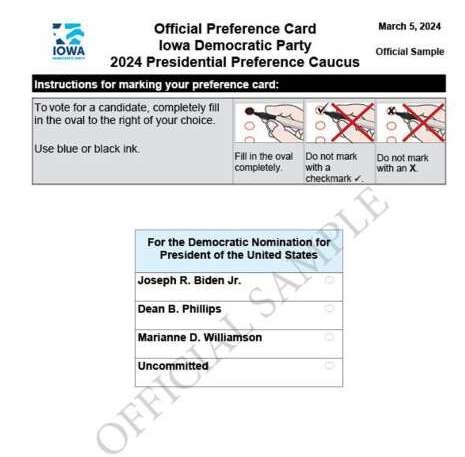
Why did the terms “preference card” and “mail-in caucus” annoy me so much? Because the language is part of the denial.
After the 2016 de facto dead heat in Iowa, the DNC adopted a rule
saying caucus states had to include a recountable document – since you
can’t re-count the heads when they are no longer in the room.
In discussions with New Hampshire, IDP learned that the word
“ballot,” and especially the process of qualifying for a ballot, were
key elements of what the New Hampshire Secretary of state considered the
difference between a “caucus” and an “election.” So IDP came up with
the term “presidential preference card” (NOT a “ballot”) and made them
all write-in (thus there was no process to qualify).
In this cycle, with Iowa Democrats officially scheduled after New
Hampshire, we should no longer care if the term “ballot” triggers them. A
little common-sense language would have gone a long way toward
convincing critics that IDP really is committed to a new post-First era.
Yet IDP insisted on calling something that any reasonable person
would call a “ballot” a “preference card” instead, and called their
mail-in voting process a “caucus.” That sent the message that they
consider 2024 a temporary setback and that the “natural order” will be
restored in 2028. At least this time they put candidates’ names on the
“preference cards.”
The media was part of the problem.
With few exceptions, state journalists uncritically parroted IDP’s
Newspeak terms “preference card” and “mail in caucus” in the few stories
that publicized the process.
Granted, process stories aren’t as fun as chasing candidates. The
state press and IDP could do little about the fact that Biden was not
going to actively campaign here. In 2012, Barack Obama wasn’t here much
either—but he had a large campaign presence in Iowa, which was still a
swing state. In 2024, Iowa is about electoral vote 420 on Biden’s depth
chart.
So there wasn’t much Democratic news to report. But the stories that
did run tended to be too late and too vague—“Deadline to request
preference card is today” was a typical story. Confused voters would
call their auditor the next day (as the deadline fell on President’s
Day) only to be told it was too late and there was no way to vote in
person. And when the “preference cards due today” stories landed,
auditor staffers like me had to field phone calls from voters standing
outside their polling places wondering why they weren’t open.
It didn’t help that there was publicity, including two tweets from
Vice President Kamala Harris’s account, listing Iowa as a Super Tuesday
state and urging people to go out and vote.
The party needs a better publicity plan.
This may be the most realistic place to expect improvement.
If we will be stuck with this hybrid process for the future, which
seems likely, Iowa Democrats need to find better ways to get the word
out and boost turnout. The public expectation—a mass mailing to all
registered Democrats—is too expensive for a financially challenged
party. But the online request process required voters to already be kind
of in the know about the inner workings of the party, and confused many
older voters. And, again, there was no confirmation email to indicate
the request had been successfully completed.
Maybe a contested nomination process will take care of the publicity.
We will never again see the kind of candidate resources we saw back in
the days of First, but even as a Super Tuesday state we’ll see more than
the nothing we saw this cycle.
Democratic legislators need to introduce a primary bill.
The lack of a primary bill makes it look like Iowa Democrats are more
committed to the donor class (who feel they have a constitutional right
to personal phone calls from presidential candidates) than to our role
as the party of voter rights.
We are past the “funnel” deadline for the 2024 legislative session,
but there is still time to offer amendments, and there are still
election bills pending. I know it won’t pass, and there are of course
many other priorities this session. Yet legislators had time this week
to introduce two dozen troll amendments to the Don’t Tread On Me license plate bill.
A primary bill is still valuable for the purposes of discussion, and
to show national critics that Iowa Democrats are committed to change.
The sooner the Iowa Democratic Party truly lets go of its early state
fantasies, the sooner we can start undoing the damage Republicans are
inflicting on our state.
The truth is, The Iowa Democratic Caucuses As We Knew Them died on December 1, 2022. That night the incumbent Democratic President of the United States said "Our party should no longer allow caucuses as part of our nominating process," and announced a calendar of five early states that did not include Iowa - a decision quickly ratified by the Democratic National Committee's Rules and Bylaws Committee.
What followed was ten months of denial and secrecy by the Iowa Democratic Party which finally ended Friday with an announcement that the party would release the results of the "mail-in caucus presidential preference" on March 5, Super Tuesday, the earliest date allowed by the DNC.
And after all that delay, the final plan looks a lot like what I recommended on December 10: hold the caucus meeting on the same night as the Republicans (which turned out to be January 15, 2024) but only conduct the legally required business of electing precinct level officers and uncommitted delegates. Then after the caucus, at a later date that was compliant with the DNC calendar, we could conduct the mail-in presidential vote.
That's exactly what IDP is going to do, according to an email sent to "SCC Members, Leaders, and Friends" just three minutes before the Friday press conference, which is basically no different that reading it in the Des Moines Register.
What took so long? No one really knows, because IDP leadership was very tight-lipped about the "vigorous and lengthy negotiations with the DNC" from December till this week. Rank and file Democrats deserve to know the details of that. I have a strong opinion but no evidence. Let's just say I think Georgia removing itself from an early Democratic state slot scheduled for February 13 or 20, because Georgia Republicans would not cooperate, was a key factor in the delay.
The entire process was too closed, too secretive, and too long. We should have been discussing how the 2024 process could and should work, in public, way back last winter, with Iowans and not with national committee members, and made the announcement in spring or early summer. That would have set expectations and reduced confusion.
The delay also made it impossible for President Biden and his supporters to start planning for the fall 2024 campaign, because of extremely strict rules against campaigning in non-calendar compliant states. We had to watch fringe candidates Marianne Williamson and Robert F. Kennedy Jr., chaos agents who could care less about rules, speak unanswered at the Iowa State Fair and get free media, while local activists had to worry about whether we were allowed to dust off an old Biden-Harris 2020 sign for a parade - all because IDP refused to set a contest date.
One thing we do know, from the last minute message to the grassroots leaders, is that IDP is playing for the future. "A fight right now over the early state calendar only weakens Iowa Democrats’ future chances," said IDP Chair Rita Hart. "I have repeated reassurance from the Rules and Bylaws Committee and its co-chairs that the presidential nominating calendar discussions will once again be opened up for 2028."
DNC Member Scott Brennan is more direct: "We intend to be first in 2028." Slow down, Scott.
True, Hart and Brennan recognize an important reality: 2024 doesn't matter. It matters even less now that Kennedy is taking his ball and going home for an independent campaign. And there is a certain benefit to Iowa's somewhat cooperative approach to the DNC, as opposed to New Hampshire's defiant insistence that they will break the calendar to stay First. (If they follow through, their delegation could and should not be seated at the national convention at all.)
But this Play For 2028 approach is one more sign of denial. Treating 2024 as a temporary setback means we won't be focused on building an Iowa Democratic Party for a post-First future. We'll still be counting on the national campaigns, organizers and money to come in and do it for us, like they have for the last 50 years - just not this one cycle. And we'll be spending 2025 and 2026 distracted by the Rules And Bylaws Committee again, just like we spent 2022 and 2023.
As for this year, the Iowa Democratic Party is preparing to spend a lot of money which could be used for more important things in order to conduct a pointless vote in an uncontested renomination race, simply to prove that we have learned how to count votes after our problems in 2016 and 2020, in the hopes that if we succeed, all will be forgiven and we will be restored to our "rightful" place on the calendar. We have county auditors who can count votes, at taxpayer expense, but more on that later.
The reality is, there are no "Iowa Democrats' future chances." The whole point of the DNC calendar reform was to get rid of Iowa (and take New Hampshire down a notch). They didn't like our process, they didn't like our demographics, they didn't like our recent election results, and they didn't like our arrogant attitude that First was our birthright.
Four more years won't make us significantly less of a red state - rebuilding will take Iowa Democrats much longer than two cycles. It won't make us any less old or any less white or any less rural. And exile from the early states for one meaningless re-election cycle won't be enough punishment for a lot of corners of the party. Maybe we'll get some other small token of appreciation for behaving better than New Hampshire, but Iowa doesn't deserve to be considered for an early state slot until we get a state-run primary and until we win some elections.
For now, I need to be just a little positive and look at some details. The timeline announced Friday is as follows:
Iowa Democrats will be able to request a presidential preference card (sic) starting November 1, 2023.
Presidential preference cards (sic) will be mailed starting January 12, 2024.
Iowa Democrats will hold our in-person caucuses January 15, 2024.
The last day to request a presidential preference card (sic) is February 19, 2024.
The Iowa Democratic Party will release results of our 2024 mail-in caucus presidential preference (sic) on March 5, 2024.
Iowa Democrats will accept presidential preference cards (sic) postmarked on or before March 5, 2024.
First of all, let's use honest language. Now that we don't have to play word games with the New Hampshire Secretary of State, let's drop the stupid and confusing term "presidential preference card." It's a ballot. And it's not a "mail-in caucus presidential preference" - it's a party-run primary.
The first ballot request date, November 1, is really, really soon. It's still not clear what form those requests will take. If they're on line, accommodation will need to be made for those without computers. If they're paper, they'll need to be distributed somehow. And there are many people who will only be able to get a request form if someone prints it and mails it to them, which is an expense. Who does that - the state party or the locals?
Ballots will be mailed January 12. There is a five week overlap period when requests will be coming in and ballots will be both be coming in and going out. This overlap period includes Caucus Night. That means some people will come to the caucus with their ballots in hand and will want to turn them in. I would also expect IDP to include ballot requests in the caucus materials. That's a lot of stuff to juggle for a volunteer caucus chair and there's a risk of ballots getting misplaced. It might be better to hold off on mailing the ballots just four days, until after the caucus.
That said, many people will not trust the post office with a ballot and will want to return it in person. In earlier versions of the plan, IDP talked about county drop boxes. How will county parties be expected to manage and safeguard that? The average county chair does not have a box that's built like a tank and a 24 hour security camera like an auditor does.
The party plans to both announce results on March 5 and accept ballots postmarked March 5. That's going to mean a second set of results after caucus night to include the late arrivals. I think this is a rhetorical point. IDP wants to complain about the recent Republican driven change in state law that requires ballots to arrive before polls close on Election Day. Fine - but we'll need to set some specified cut-off date.
As for March 5, I was hoping for a different date. Iowa's results will be buried in the flood of results from both parties in other Super Tuesday states (to the extent that anyone cares about Biden 98%, Williamson 2% results). I would have preferred county convention day, March 23. This would have been a fun news handle for the county conventions (to the extent that anyone cares about Biden 98%, Williamson 2% results). But, as I expected, IDP clearly decided that the important thing was to go as soon as possible to emphasize that we really, really want to be an early state again.
Not discussed in the party release: Whether or not names will be printed on the ballots, and if so, the process to qualify. Will they be machine countable, which is way more accurate than a hand count? If not, are we going to quibble about whether "Joe" or "Biden-Harris" or "Bidin" votes will count?
So there's a lot more details to be fleshed out, and that will need to happen in less than four weeks before those requests start coming in.
In the big picture, there is good news. The most important change happened months ago, even before Iowa Democrats were demoted in the calendar. The old system where people had to stand in the corner for hours of endless headcounts and realignments, in crowds of up to 900 people, is over. Anyone who simply wants to vote for president does not need to attend a meeting at one and only one specific time and place. Since Iowa Republicans will not cooperate with an auditor-run primary election, a mail-in party run primary is as good as Democrats can do. The party of voting rights needs to contrast our improved, inclusive system with the same as it ever was Republican caucus where if you cannot attend, you cannot vote. And we should push for more.
The next legislative session starts very close to caucus night. Democratic legislators should emphasize voting rights by introducing a bill for a real, auditor-run Iowa presidential primary. It doesn't matter that Republicans won't assign it to a committee. It's a point that should be made and it's a point that will make national news. And, if you think trying to get back into the early states is important, it's a point that will help our standing with the rest of the national Democratic Party.
In the wake of the special session there's been a lot of Run For Something talk. I've been that person who ran and lost a tough race no one else wanted to run. It's been a while but the fundamentals haven't changed much. I don't want to throw water on anyone or be a gatekeeper. I just have experience and advice. Some of it's hard. You can accept or reject as you like (remember, I lost)
I’m not going to talk about ideology - reasonable people disagree on the best approach - or biography – you are who you are. I’m talking about universal constants.
First off: You will probably lose. You need to be OK with that. There are a LOT of reasons to run besides winning yourself. If you can move the needle for the top of the ticket a few points in your direction, you've accomplished something and you've built for the future.
But running might not be the best thing for you, and it may be bad enough that it's better if nobody runs. Google yourself. If the first thing you find is damaging or embarrassing, know that the other side will use not only against you but against the rest of the ticket. We dodged a bullet last cycle in one area district.
Look at every social media account you've ever had all the way back to MySpace and Friendster and be prepared to answer for anything you ever posted. If you can find it, they WILL find it.
You will have to raise money. "If every Democrat in my district donates $5" is not a plan. Even if you can name the rare counter example, Magic Internet Money is not a plan. "The state party will pay for it" is not a plan. This doesn't mean "the party doesn't care about rural districts." But at some point they have to look at numbers and odds. What limited resources they have will be spent on the swing districts. Triage is cold and cruel and you will probably be triaged out like I was.
The deal is: You, personally, will have to cold call people and ask for money, starting with family, friends, and working out to party donors. You will hate this. Everyone from Joe Biden on down hates this. It's the only way.
"Money isn't the only thing." True. But without it nothing else happens. Volunteers are great but they need lit to drop, signs to put up, and something to stuff envelopes with. That's not free. You don't have to match your opponent dollar for dollar. But you have to have enough cash to be visible and credible.
"If every independent votes for me, I'll win" is not winning math. That's drawing to an inside straight. Unaffillated voters vote pretty much the same way as their neighbors who register with a party. Again, you personally winning is not the only big picture goal.
"I'll talk about the issues." You're already an idealist for taking on this tough race, and that's good. That's how it's supposed to be. That's not how it is. Your small campaign will not be able to change this.
How long have you lived in your town and been active in the community? Do people know your family? In a lot of districts this matters more than "issues." I ran a year after I moved into the district and I was VERY clearly an outsider. I was a terrible fit, but it was me or no one.
How's your job? Can you afford, professionally or economically, to take time away from work - vacation days, an unpaid leave of absence? Would you even be allowed to do that? (Yes, you have some rights, but good luck with that.) It's not fair that people who are financially better off have an advantage in politics - but it's that way with EVERYTHING.
All those tough things said, my people in the district were very grateful I did what I did, and I'm proud of it. It was a learning experience that made me better able to help other candidates. I like to think my little campaign helped Bill Clinton and Tom Harkin win Louisa County. I made some long term friends. And some of the people who helped me went on to bigger and better things.
I'll end on a couple positive recommendations.
You should spend as much of your time as possible doing the things that only you can do. That means talking to voters and it means the lion's share of the money asking. It also means your Human Being Stuff - being a partner/parent/adult child, your day job, and your other personal stuff that can't be delegated. But everything, on the campaign side and personal side, should be delegated when possible. Candidate spouses are the real heroes.
Finally, be yourself. Not everybody is going to like you. But everyone hates a phony.
You can't compare any Billboard chart records pre-1991 to post-1991 or
pre-1999 to post-1999 because of the way marketing and chart rules have
changed.
There's six distinct Billboard chart eras:
Pre-Hot 100 - multiple singles charts for airplay,
sales and jukeboxes, often with different Number 1s at once. Pre-rock
transitioning to rock (peak Elvis is pre-Hot 100). Long peaks,
especially for non-rock songs. Multiple versions of the same song often
chart simultaneously (the good original version and the lame Pat Boone
cover).
The pre-Hot 100 "Top 100" was dated on Wednesday from 11/2/55 through 6/19/57.
There was a three day "week" with the chart date moving to Saturday
on 6/22/57. It stayed Saturday until 7/19/58, the last Top 100.
There was no chart Sat 7/26/58 or Mon 7/28/58.
1958-late 70s - Hot 100 comprehensive chart debuts
Monday 8/4/58. It was a Monday date through 12/25/61. It's not entirely clear whether there was a Saturday 12/30/61 chart.
If you click on that date on the Billboard website it gives you the
1/6/62 chart. However, some sources list unique data for a 12/30/61
chart. In any case, this was the point of transition from a Monday chart
date to the Saturday chart date, where it has remained since.
Data was self-reported by stores and stations, often manipulated
(payola). Single release required for Hot 100 eligibility. Some famous
album cuts (Stairway To Heaven) ineligible.
Glory days of Top 40 radio. Rapid chart turnover. Short songs, with a
norm of 3 minutes, though this grows steadily with time (landmarks:
Like A Rolling Stone, Hey Jude. Elton John's singles regularly exceeded 5
minutes.) Albums become important mid to late 60s (Sgt. Pepper). Record
sales grow throughout the period. Artists released an album or two
(Beatles, Elton John) per year, but usually only one to three singles
per album. One off non-album singles are common.
Long chart peaks (I Want To Hold Your Hand 7 weeks at Number 1, Hey
Jude 9) fade away around 1970, and vanish by 1976. In 1974-75 one week
at Number 1 was the norm and four weeks would get you Number 1 for the
year. Chart runs over 20 weeks are rare.
The All Beatle Top Five was a unique anomaly driven by America's
delayed case of Beatlemania; rights to the early material were split
among multiple labels. Once the early material had all been released in
America, this didn't happen again. For my money, given the differences in rules and patterns over the years, the All Beatle Top Five remains the greatest chart achievement.
Another major chart outlier in this era is The Twist due to its two
Number 1 chart runs 18 months apart. Until very recently The Twist was
called "the biggest hit of all time" (again my whole point is that
comparing across eras is impossible).
Late 70s - November 1991- Same chart rules, but
different patterns due to different record release strategies. Top 40
Radio fragments and loses its cultural dominance to MTV. Long chart
peaks briefly return 1977-82 (You Light Up My Life and Physical 10
weeks, see also Night Fever, Endless Love, I Love Rock & Roll) but
vanish by the mid-80s (When Doves Cry at 5 weeks in `84 was about as
long as it got - unfortunately for Bruce Springsteen who was stuck at 2
and never did get a Number 1).
Songs start to get longer with the average closer to four minutes;
the Casey Kasem countdown expanded from three hours to four.
Record sales plummet fast in the fall of 1978 (notorious flops: Sgt.
Pepper Soundtrack, the Kiss solo albums). Albums become more important
than singles and cassettes start to take over from vinyl (with CDs
emerging late in the era). Sales grow back as the formats change.
Chart runs for singles get a little longer (Tainted Love sets a
record at 43 weeks) but rarely get beyond six months. What happens
instead:
The Long Album Cycle begins, with acts releasing four (Rumours),
five (Purple Rain, Sports, Heartbeat City), or even seven (Born In The
USA, Thriller, Rhythm Nation) singles from an album over cycles lasting
up to two years. Non-album singles become rare. Still some unity to pop
culture (Thriller), with Nirvana being the last mass culture moment.
From 1976 to 1991 the chart was "frozen" over the holiday week. This
does not mean "Let It Go" was Number One. The end of the year issue was a
double issue focused on year end charts and Billboard skipped a
publication week. Officially these unpublished magazine weeks are chart
dates, but the chart is identical to the prior week (all positions were
"frozen"). In most cases the pre-Christmas #1 song held over, but there were exceptions:
1/1/77: Rod Stewart got credit for an 8th week at #1,
a LOT for that era, but fell out of #1 on the 1/8 chart. Did he REALLY
hold on for an 8th week or would Marilyn McCoo and Billy Davis Jr have
knocked him off a week earlier if there had been a fresh chart?
12/30/78: #1 transition the next week, Le Freak to Too Much Heaven
12/29/79: #1 transition the next week, Pina Colada Song to Please Don't Go.
November 1991-December 5, 1998 - The Soundscan Era, the
CD era. A transitional era for charts. Direct collection of data begins
in November 1991 and chart patterns change immediately - but single
release is still required for Hot 100 eligibility. But this is when the
vinyl single dies, and CD and cassette singles never sell as well as the
glory years of 45s. Thus radio airplay dominates the charts.
The beginning of extreme long chart runs (How Will I Live, You Were
Meant For Me at about 15 months each) and long Number 1 peaks (I Will
Always Love You and Macarena at 14 weeks, One Sweet Day at 16).
The album and airplay charts were more accurate indicators of real
popularity than the Hot 100 as many key hits (Iris, Don't Speak) were
not issued as singles in order to to boost CD sales (the "one good song
on the CD" era). This contributed to long #1 peaks as the competition
was weaker for the songs that WERE chart eligible (Candle In The Wind
1997 and Unbreak My Heart).
High chart debuts begin in 1995. This culminates in the first Number
1 debuts (MJ again with the quickly forgotten You Are Not Alone).
Debuts were often manipulated by delaying the limited quantity but
chart-required single release until airplay peaked (Sunny Came Home).
Beginning with the weeks of 12/26/92 and 1/2/93 Billboard ended their "holiday freeze" and resumed publishing unique charts over both Christmastime weekends.
December 5, 1998-circa 2010 - Early modern era.
Album cuts become chart eligible, and in 2000 Aaliyah earns the first
Number 1 single without a single. The iPod and download era (legal and
not). With MTV abandoning music videos, and everyone with headphones
serving as their own DJ, the mass culture era ends. Still primarily a
singles era (begins to change with Taylor Swift's 2008 album Fearless
becoming a proto-chart bomb). Number 1 debuts nearly vanish except for
American Idol stars.
Several longevity records set, with Black Eyed Peas holding Number 1 for 26 straight weeks.
The 2000s marked the rapid growth of the "Featuring" credit, as
collaboration becomes a norm with the singer singing the hook or
multiple rappers taking a verse. This skews chart stats a lot, in
particular numbers of hits stats.
2010-present - The modern era. Streaming emerges as
the primary medium. Number 1 debuts return and become almost the norm.
Chart manipulation moves from the payola/false reporting problem of the
Classic Hot 100 Era to the fanbase model (bulk purchases, endless loop
streaming, etc - Nicki Minaj and KPop fans are particularly rabid at
this, though Swifties are not 100% innocent. Many artists play into it).
Chart rules frequently change to try to stay one step ahead - see the
ban on "bundling" (free single with purchase of tickets or merch).
The "remix" also became a chart factor. This has been around for 20+
years (J Lo's "I'm Real") but in the late 10s and the 20s it's a big
chart tactic.
It's not uncommon for a song to reach Number 1 without having ANY
impact on the larger pop culture outside the act's core fanbase (the
"stans"). Huge Week 2 drops are common (BTS member Jimin's solo single
just dropped from 1-45 for a new record. Nicki Minaj dropped 1-34 and
Swift dropped 1-38 though that was mostly due to the Holiday Chart
Bomb).
The rare "stable and organic" hits stay at Number 1 for months (Old
Town Road a record 19 weeks, As It Was 15, Despacito 16, Uptown Funk
14).
Beginning of the serious Chart Bomb Era where many or even all songs
on a superstar album (primarily Swift and Drake, but others like Bad
Bunny) debut at once. Compare 26 out of 30 tracks on the Hot 100 for Red
TV vs. zero of 30 for the no-single White Album. First the Beatles 14
of Hot 100 record fell. Then Drake tied the All Beatle Top Five. Finally
Taylor occupied the entire Top Ten.
Most chart bombs are short as the non-singles ("single" being more a
mood than an actual format, signaling radio promo efforts or video
releases) drop fast the 2nd week (though the biggest tracks from Swift's
latest album have shown some longevity in the low to mid rungs).
A minor variation is the Necro Chart Bomb when an artist dies
(Prince, Petty, Bowie) and their greatest hits re-chart for a week.
Starting in the late 2010s there's also a four week or so Holiday
Chart Bomb when the same core group of Christmas songs returns each
year, breaking lots of chart records related to slow climbs, fast drops,
and multiple runs (All I Want For Christmas Is You taking 25 years to
hit Number 1, hitting Number 1 in four separate chart runs, and dropping
from Number 1 to completely off the chart three times).
Each year the Holiday Chart Bomb gets bigger and longer. This has
the side effect of interrupting otherwise long consecutive chart
streaks, as holiday songs push down non-seasonal songs and trigger the
Recurrent Rule (dropping below 50 after 20 weeks gets you dropped from
the chart) or the Super Recurrent rule (dropping below 25 after a year).
It also leads to high re-entries like "Blinding Lights" returning at
number 3 the week after Christmas. I'm not at ALL a fan of the Holiday
Chart Bomb (for decades Christmas songs were only listed on a special
holiday chart - a policy I believe should return).
Chart turnover is low and slow except for weeks with chart bombs.
Songs stay on the chart either one week (Glee Cast, chart bombs),
exactly 20 or 52 weeks, or forever: 90 weeks, including over a year in
the top ten, for the new "biggest hit of all time" Blinding Lights, and
91 weeks for Heat Waves which took 59 weeks to reach Number 1. Songs
peak either in Week 1 or in Week 46 or so, with country tracks lingering
for months in the low chart rungs and slowly building.
Some acts accumulate insane numbers of "Featuring" credits (Drake,
Minaj, Lil Wayne). In contrast, nearly all of Swift's hits are as a solo
artist or in a handful of cases Swift as the lead artist with a guest.
However the re-recordings have racked up roughly 40 duplicate hits ("You
Belong With Me" and "You Belong With Me Taylor's Version" are
considered separate chart entries).
With numbers of streams, and quick hooky viral videos, becoming more
important, the average length of hits has dropped back toward the three
minute mark. One stream of a song is one stream, whether it's the 1:52
original version of Old Town Road or the 10:13 long version of All Too
Well (making Swift's achievement of Number 1, and the longest running
time Number 1 ever, all the more impressive).
Tuesday, April 11, 2023
I never said the blog was dead. It's only semi-retired, and I have always reserved the right to don the beret as needed for special occasions. So on this Easter Monday the blog rises from the grave.
It's been a long Iowa caucus tradition that the two parties set aside their policy differences and work together on process issues. It's also been a long tradition that the parties don't tell each other how to conduct their own business. You want to have a straw poll and call it a caucus? Fine. You do you. We'll be over here counting our preference groups.
That tradition has been stained to the breaking point in the months since the two national party committees made different decisions about Iowa's traditional First role - the Republicans keeping Iowa first, the Democrats completely banishing Iowa from the early state window.
This week, that bipartisan tradition snapped entirely. The final break was House Study Bill 245, a late session surprise from Rep. Bobby Kaufmann - a Trump campaign advisor and the son of the state party chair. Given the prominence of the sponsor, the unusual method of introduction, and the late date, I'm assuming this will pass.
The bill makes two key changes in caucus process. The first change ends the long bipartisan tradition that Iowas can register to
vote or change party on caucus night. The bill would instead require
voters to choose and register with the party 70 days before the
caucuses.
It's clear what's at play here. The Trump wing of the
Republican Party of Iowa is worried about anti-Trump Democrats and no
party voters crossing over. But guess what? Crossovers happened EVERY
time there's a caucus in a re-election cycle, as
independents go where the action is.
But if Iowa Republicans
suddenly see that as a problem, they can change their process without
changing the law. They can simply make the 70 day requirement a party
rule. Is that mean spirited and vote suppression? Sure, but it's their
party event and thus their business. You set your rules, and let us keep
our doors open to people who want to join the Democrats on caucus
night.
The other change would lock the caucuses into the status quo of 2012 and earlier by requiring caucus voters to attend the precinct level caucus in person.
This is designed to kill the Iowa Democratic Party's plan to separate the presidential vote from the caucus itself, and conduct a by mail presidential preference process. It would also kill the satellite caucuses that were attempted in 2020 and on a very small scale in 2016 - even though most of those were at the same time as the precinct caucuses. There were serious flaws and inconsistencies to the satellite caucuses, but they did open up the process to some people who could not attend.
Even the Republicans had a very limited caucus participation program for military and overseas voters. I look forward to the Kaufmanns explaining to our troops why they can't vote.
Republicans may be concerned that the New Hampshire Secretary of State will call the Democratic mail-in process an "election" and move New Hampshire's date in front of Iowa. They are also worried that people might vote a Democratic absentee ballot, then attend a
GOP caucus.
That seems to be an exaggerated fear for this cycle, since the Democratic nomination is not likely to be seriously contested. No one's going to want a Democratic mailed ballot except the committed party activists and the leftists who want to cast an anti-Biden protest vote. Neither group is likely to show up at a Republican caucus. The people who might be inclined to monkeywrench the Republican process
are the same people who care about being on the county central committee
or about getting their platform resolution passed.
Going forward, if there even is a going forward, double caucusing is legitimate concern and a challenging problem. But it
should addressed by the two parties working together and finding an
answer that works for both of their processes.
You know what system works to allow absentee voting and prevent people from participating in both parties process? A state run primary election.
But that's clearly not going to happen - even Democrats didn't introduce a for-show bill - and this bill clearly is. So what do Democrats do?
The Republicans clearly want us to run our caucuses just as we did in 2012 and earlier (with the elimination of the questionable "improvement" of the satellite caucuses, and the addition of the early party registration requirement). That is the absolute last thing we should do, for all the reasons of disproportionate representation and inaccessibility and exclusion that I have talked about for years. (Granted, the overcrowding would not be as bad in a re-election year.)
That gets us in even more trouble with the DNC than we're already in. First off, the sitting Democratic president and presumptive nominee has directly said "Our party should no longer allow caucuses as part of our nominating process." Second, we are likely going to be dragged along by the Republicans into holding our caucus on a date that does not comply with the DNC calendar. Eliminating the mail-in vote would break yet another rule - the requirement that caucus states have an absentee process. It seems increasingly unlikely that Iowa's national delegation will be seated at the Chicago convention.
Making Iowa Democrats look bad is not the GOP's main motivation here - I'm convinced this has more to do with internal Republican politics - but it's a nice bonus.
As I outlined in December, it was possible for the Iowa Democratic Party to both comply with state law and still follow the DNC calendar rules. State law does not say that we have to vote for president before any other state. It simply says that we need to hold a caucus and elect precinct level party officers before other states vote for president, The law does not require a presidential vote at the caucus - and I see nothing in HSB 275 that changes that.
Iowa's original plan, as presented by then-chair Ross Wilburn to the DNC Rules And Bylaws Committee last August, was to conduct a mail in presidential vote in the weeks before the caucus night meeting, announce the results on caucus night, and then conduct the legally required party business at the caucus. My proposed variation on that would be to have the caucus meeting, but then hold the mail in vote later, at a calendar compliant date.
Maybe such a vote in March of 2024, or a straw vote at a county convention, could be called something other than a caucus and used to allocate the national delegates. Or maybe it can't.
Another piece of bipartisan cooperation has fallen by the wayside. It's a
lousy trick to blindside Democrats this late in the session.
Iowa Democrats were blindsided by our own national party in 2019. In order to address the new requirement of an absentee caucus system, we spent months planning a phone-in "virtual caucus" system - only to be told with no warning just four months before the caucuses that it was unacceptable.
Now we're getting blindsided by our fellow Iowans - who used to be our allies on caucus issues.
If
the Republican position was always going to be "Democrats doing a vote by mail caucus is
unacceptable" - and I'm pretty sure that was the case - they should have
signaled that ASAP. We should have know that before Wilburn even presented the idea to Rules And Bylaws. Months of planning time have been lost.
Also lost are all the benefits Iowa Democrats used to gain from first. Now we're boxed into a position where we will have to scramble just to comply with state law and have a meeting, and where the biggest win we can hope for is getting seated at the national convention with hotels closer to the United Center than to Davenport.
A couple years ago I raised the idea that Iowa Democrats may have no presidential nomination process at all - that our caucus process would be prohibited and that at some point the state party leaders would quietly choose a delegation. The first part of that has already happened. It's looking increasingly likely that rank and file Iowa Democrats will never get any chance to express their personal presidential nomination preference.
As Iowa Democratic Party leaders struggle through the denial stage of the grieving process, they are clinging to a state law that supposedly privileges Iowa’s historic first place on the presidential nomination calendar.
In an email sent to party activists on the evening of December 1,
soon after President Joe Biden announced his support for a Democratic
nomination calendar that does not include Iowa among the early states,
party chair Ross WIlburn wrote:
Our state law requires us to hold a caucus before the last Tuesday in
February, and before any other contest. When we submit our delegate
selection plan to the Rules and Bylaws Committee early next year, we
will adhere to the State of Iowa’s legal requirements, and address
compliance with DNC rules in subsequent meetings and hearings.
While the law itself is ridiculous—what if 49 other states pass the
same law?—Iowa Republicans are also pushing the “state law” argument. In
part they want to make the Democrats squirm. But also, Republicans have
grounds for concern that if Democrats follow the new Democratic
National Committee approved calendar, it will hurt the Iowa GOP’s
chances of staying First on their side, which the Republican National
Committee has approved for 2024.
The Iowa Democratic Party is in a jam. If we go along with the
Republicans, the DNC penalties are draconian. There are strict
restrictions against candidates campaigning in calendar breaking states,
and there would be an automatic reduction by half in the state’s
national convention delegation. Stricter sanctions could be imposed,
including kicking the Iowa delegation entirely out of the convention.
And the DNC will not hesitate to impose the harshest punishments on
Iowa. The president himself said, “Our party should no longer allow
caucuses as part of our nominating process.” We learned in the Rules and
Bylaws Committee discussion just how much other states hate our poor
track record and our complicated process.
Unlike New Hampshire, which is also making loud threats to break the
rules, we do not have two Democratic senators or swing-state status to
protect us. We are the perfect state to make an example of. We are too
weak within the national party to get away with breaking the calendar
rules, and too weak within the state to get the law changed.
But we don’t need to. Iowa Democrats can both follow state law and be in compliance with the national calendar. It’s not hard; you just have to read the law.
Delegates to county conventions of political parties and party
committee members shall be elected at precinct caucuses held not later
than the fourth Monday in February of each even-numbered year. The date
shall be at least eight days earlier than the scheduled date for any
meeting, caucus, or primary which constitutes the first determining
stage of the presidential nominating process in any other state,
territory, or any other group which has the authority to select
delegates in the presidential nomination.
Despite the way both parties are spinning it, 43.4 does not say parties must conduct a presidential preference process at the caucus.
In fact, Republicans had a long tradition of not holding a
presidential straw vote at their caucuses in years when their incumbent
presidents were seeking re-election. They changed that policy in 2020,
but Republicans did not hold a vote in 1984, 1992, or 2004. The decision
was somewhat controversial in 1992, when Pat Buchanan won nearly 40
percent of the vote in the New Hampshire primary against President
George H.W. Bush.
All 43.4 says is that parties have to elect their precinct level
officers before any other state starts its presidential nomination
process. The DNC only cares about how early Iowa is voting for
president. No one cares when we elect Central Committee members and
county convention delegates.
So Iowa Democrats should go ahead and do that—and only that.
The caucus date is uncertain, because New Hampshire is likely to
insist on following its state law and hold the first primary a week
before any other state. That will trigger Iowa Republicans to move their
caucus date back. Iowa Democrats are just along for the ride (albeit
willingly).
On whatever night the Republicans set, Democrats should have a
mid-term style caucus to debate the platform and elect committee members
and delegates. But it needs to be made clear that election as a
delegate is in no way linked to presidential preference. The
handful of activists who attend off-year caucuses, or who stayed late in
presidential years after the hours-long nightmare of realignment, would
attend.
So when do we get to vote for president?
In a December 6 email to county chairs, Wilburn outlined a few more
details of the somewhat vague vote by mail plan he and Scott Brennan
presented to the Rules and Bylaws Committee over the summer.
JANUARY 2, 2024
First day for the Iowa Democratic Party to receive requests by mail
or online portal, and send preference cards to registered Iowa
Democrats.
14-28 DAYS PRIOR TO THE IN-PERSON CAUCUS
IDP Chair opens the non-present participation period of the caucuses.
Caucus-goers may return their preference cards by mail, in-person, or
drop box. The non-present participation period will continue for at
least 14 days. During this time, Democrats may continue to request a
preference card.
5 DAYS PRIOR TO THE IN-PERSON CAUCUS
Last day to postmark or hand-return preference cards
1 DAY PRIOR TO THE IN-PERSON CAUCUS
Deadline for Iowa Democratic Party to receive mailed preference card (Note: this would likely be a Sunday, with no mail delivery)
CAUCUS DAY
The Iowa Democratic Party will release the raw caucus results by a
time certain to the public. Caucus site coordinators will receive both
the raw results and delegate allocation results for all precincts at
their site, and announce the number of delegates to be elected for each
candidate (or uncommitted) in each precinct.
One good thing that came from the calendar reform process, and from
the survey the Iowa Democratic Party conducted over the summer, is that
no one is continuing to defend the old “stand in a corner for three
hours to vote” system. The reformers have already won that battle.
Many details need to be thought through before implementing a vote by
mail system, and that work needs to start very soon. The process will
also be expensive, which a financially weak party will need to address.
But the vote by mail concept is a good framework.
The timeline simply needs to be moved into compliance with the new DNC calendar.
After the precinct caucuses, the traditional next step of the process
is the county convention in March. That’s a perfect time, outside the
early state window that we are no longer a part of. We can make the
county convention the new centerpiece of the presidential preference
process.
IDP should schedule the proposed 14 to 28 day vote by mail window to
begin between Wednesday, February 28 and Friday, March 1, on whatever
day the early state window is officially considered closed. We can then
spend the month of March voting, which is a nice long early voting
window like we used to have in this state.
Democrats should then announce the presidential preference vote
results at each county convention, on Saturday, March 23 or 30. This
creates actual news out of the convention, to whatever extent “Biden 99
percent, Uncommitted 1 percent” is news.
(One under-discussed aspect of the calendar change is that President
Biden weighing in so strongly is an indicator that he is running for
re-election, so the 2024 Democratic cycle is likely to be uncontested.
That gives Iowa Democrats a low-key, low stakes cycle to work the bugs
out of our new system before a contested 2028 cycle.)
County conventions can proceed to elect pledged congressional
district and state convention delegates, based on the results of the
preference vote announced that morning.
The Congressional district and state conventions would proceed much
as they always have and elect pledged national delegates. And, with Iowa
in compliance with the DNC calendar, those delegates would be seated at
the national convention with full votes and no penalties.
This plan is very close to what IDP presented to Rules and Bylaws.
The only thing that changes is the time frame of the mail in vote. The
Republicans already set the precedent that we do not need to have a
presidential vote at the caucuses and we can simply elect unpledged
county convention delegates. Delaying the presidential voting to March
not only complies with both state law and party rules, it preserves as
much of the Democrats’ traditional caucus to convention process as
possible, given our removal from the early state window. The only thing
it does not preserve is First As We Have Known It.
Of course, all this assumes Iowa Democratic leaders want to comply
with the DNC calendar. All indications are, they do not. Let’s be honest
here. “Following state law” is just an excuse. The real concern is
keeping the privileges of First: the command performance cattle call
events, the year and a half of candidates and organizers blanketing the
state, and most importantly to some, the personal phone calls from
presidential candidates to key state players.
State law says we
have to elect delegates and central committee members early. It does not
say that South Of Grand donors have a constitutional right to have
Kamala Harris and Pete Buttigeig’s cell phone numbers. It does not say
that small county chairs have a right to be quoted in the New York
Times. It does not say you have a right to collect selfies with
presidential candidates. We did this to ourselves, over many cycles and
with many mistakes.
Iowa Democrats are in the weakest position we have been since the
pre-Harold Hughes dark ages. It’s not just First that we have lost—it’s
the entire way we have done things for 50 years.
Every hour and dollar wasted on fighting a battle for First that is
already lost is time and money not spent building for the future. First
will be very hard to replace. But accepting the loss and accepting our
diminished role in the nomination process is a necessary first step in
the long hard fight toward winning back the state.
I never set out to be The Caucus Organizer for the Johnson County Democrats. The role landed on me by accident in 2004. Nearly every experienced party activist was involved in a presidential campaign, and almost no one was doing the logistics work of finding rooms, recruiting chairs, stuffing packets, and getting training done. The skill set overlapped closely with my job at the county auditor's office, so I stepped in to help.
Each cycle, my role got bigger and bigger. By 2016 I was seen as the Person In Charge, a role I repeated in 2020 and again in the recent midterm caucuses.
But after a lot of struggling, I've decided it's a role I won't take on again.
Each cycle, the job got bigger because the turnout got bigger. I don't mind hard work. I regularly put in 80 hour weeks during election season. But I do mind work that's futile. I do mind work that's counter-productive. And I'm no longer comfortable with enabling a system that I believe is wrong.
The first year I was involved in caucus planning, Johnson County took a great leap forward in turnout, from 4000 attendance in 2000 to over 11,000 in 2004. For the first time, we saw rooms that were crammed beyond capacity.
So we started getting bigger rooms. But the turnout kept growing - to 18,363 in 2008, even though the January 3 date meant most of our students were out of town. We jumped to 19,513 in 2016 and 21,436 in 2020. My personal caucuses kept getting bigger, too - from 100 in 2000 to 300 in 2008 to 430 in 2016 to 750 in 2020.
Some
might think that such high turnout is a blessing - wow! you must have
signed up a lot of new volunteers and committee members! Nothing could
be more wrong.
The
change of the caucuses from neighborhood meeting to mass attendance
event means more new people not trained in tradition and parliamentary
procedure, and less committed to organizing the party, who just want to vote and go
home - which 90 percent of attendees do as soon as the delegate counts are locked in.
But first we make them stand in line for 45 minutes, and then we
make them stand in a corner for three hours to vote. And this chaos is
their first impression of the local party.
The rules of a caucus are set up for 40 people in a living room. Once the caucus grows above the capacity of a grade school gym - this isn't just a Johnson County problem, the average Iowa Democratic caucus goer attended a caucus of 191 people - those rules just don't work anymore. You can't organize in a crowd
of 945 people, the biggest Johnson County caucus on record. You can
only do crowd control and anger management.
Each
cycle, I started earlier. Each cycle I booked bigger and bigger rooms,
sometimes at costs in the thousand of dollars, until we were in the
biggest indoor spaces that existed in each precinct short of Carver
Hawkeye Arena.
Better organizing and training and planning can only do so much, even if your county's volunteer organizer has 24 years of professional experience in election administration. All I managed to do was make a bad situation slightly less bad.
Spaces larger than a grade school gym, in or near neighborhoods, are few and far between. Smaller precincts, one suggestion I keep hearing, won't help - that just means we would need three grade school gyms where only one exists. All we can do is book the one gym that exists and pray that no one calls the fire marshal.
When the biggest room in or near the precinct is no longer big enough, the only answer is to get some of those people out of the room.
But the overcrowding isn't even the biggest problem. Fairness and access is the biggest problem, and that's not just logistics - it's a challenge to us to live up to our ideals.
The
Democratic Party is the party of voting rights, and we need to be the party of voting rights not just on Election Day, but on Caucus Night. We need fewer people in our caucus rooms but we need more
people in our nominating process.
We already limit who can attend a caucus by making it a mandatory must attend in person meeting - even the satellite caucuses we had in 2020 still required attendance in one place at one time and required more advance planning and pre-registration than many people's schedules allowed.
The overcrowding makes attendance a physical and mental endurance test - walking many blocks in the dark from the nearest parking space, and sitting uncomfortably or standing for hours, large
cavernous spaces with bad acoustics, and high confusing noise and
stress levels that strain the capacity of those of us on the autism
spectrum. I've seen seniors near tears at our office, begging for an absentee ballot.
A state or district party that only has to pull off one large convention can or should manage to check off all the ADA boxes. It's asking too much for a county party, with no financial help from the state party, to conduct dozens of district-convention-sized caucuses all at the same time, and be 100% compliant and legally liable if someone sues. It's not that we don't care - it's just that there aren't that many sound systems and babysitters and sign language interpreters available all at once.
There's other barriers to participation - schedules, transportation, and physical presence in your community. This one hits me close to home. My wife missed the 2008 caucuses because our sons were small and did not want to go, and in 2016 she had last minute mandatory overtime. I would have missed last month's mid-term caucus if my county had not decided to go virtual, as I was out of state helping care for my aging parents.
I'm no longer willing to book the rooms and recruit and train the chairs for the same old Must Be Physically Present process. I'm not even willing to attend anymore, knowing that there are so many others who can't.
Our long range goal should be a presidential primary. I understand all too well that Republicans control our state government and are not interested in changing. But it should still be our goal. I'm working to get it into our platform, and I'm hoping that at some point a legislator will be brave and introduce a primary bill.
While we pursue that goal, we should also work to make our last caucuses better.
The
mid-term caucus, where dozens of counties converted to a virtual or
hybrid format in just two weeks, shows that we can be really creative
and inclusive when we're given the chance.
2024 may be our opportunity to try new things.
President Biden is likely to run for re-election, which will largely
take questions of Who Benefits? out of the mix. And with the long time
New Hampshire Secretary of State retiring, we may have a chance to do what
we haven't before.
Give people what they want. Let
them vote and go home - let them vote all day long and go home. Give
them absentee ballots - real ones that they can mark at home in secret. We
should experiment with true absentee ballots, or multi-day early voting like Nevada did in 2020, or a
"firehouse caucus" format where voting is open all day long at caucus
sites, or all of these things.
I'm
not here to argue about First, or about how representative my state is. That's up to the national committee. But
I will say that we can no longer accept First as an excuse for a flawed
process. For me, it's time to work on improving that process rather
than enabling it.
Because I'm openly in favor of ending the caucuses and going to a primary, even if it costs Iowa First, I've been persona non grata at Iowa Democratic Party headquarters since the Dvorsky Administration. It was worst while Andy McGuire was chair, when I was very pointedly and publicly excluded from a caucus review committee, even when they re-opened it to add more members. I'm well aware that the 2016 committee was a Remain Calm, All Is Well sham, but excluding me was still a slap in the face.
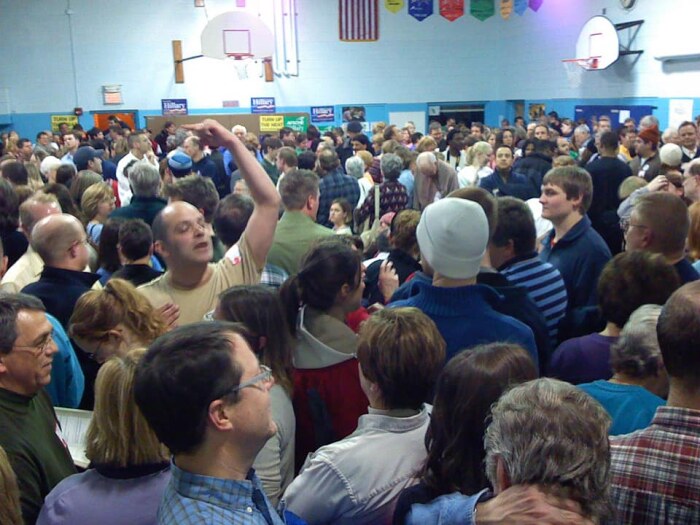
Actual footage of caucus sign in at Iowa City Precinct 17.
So for the last few years, since I'm not allowed behind closed doors and no one ever reaches out to me, I've had to make my case in public. I don't have a lot of followers, but I know that the people who do hear what I say are people who matter in this process.
I've know new IDP chair Ross Wilburn a long time, back before his Iowa City mayor days, and I like him. I know he's reasonable, but I also know he has to deal with a certain set of expectations regarding First. So I'm still going public here, but I look forward to talking with anyone who will listen.
So here's my suggestions for how we can improve the caucuses, in decreasing order of severity.
Have a primary.
I won't go too deep into that here, especially since that would require legislation and bipartisan cooperation, and the Republicans have no interest in changing the process. But the bottom line is, a primary is a more democratic process than a caucus. We need to talk about this and we need to stop the denial.
Even if the Iowa political/media establishment will not give up First and the caucuses willingly, we need to prepare for the likelihood that it will be taken from us. At some point soon, the DNC is going to ban caucuses, and we will need to adapt. In fact, assuming President Biden runs again, a re-election year when the stakes in the nomination contest are low would be the best opportunity for the DNC to make that change.
I'd like to see legislative Democrats make an actual effort to go along and introduce primary legislation, even though, given the Republican trifecta and their party's commitment to not changing the caucuses, it would be doomed to fail. Still, I would like us to be national team players.
Maybe you could still have a small, off-year style caucus for party business. I don't really care. I've long argued that the whole platform process should be abolished, because it's not binding on candidates and officials and thus, to me, meaningless. And in other states, the delegates and party committee members are either slated by the campaigns or appear on the primary ballot itself. You can argue about those things if you want - but presidential preference should be handled in the most democratic way possible.
The math is easier with a primary, too.
But I'm not just about "have a primary." If we are going to have a 2024
caucus, which I expect even if the DNC bans caucuses, I want a better
caucus. So let's keep improving...
Put the needs of ordinary voters first, not the needs of the political and media elite.
Who cares about first?
The bipartisan political elite - the inner circle
of activists and the next circle out who love the attention and the selfies and the big
names at small county fundraisers and the personal phone calls from
senators. And the state news media who love to play out their national
anchor fantasies. That's a big part of why the state media downplays
anti-caucus views.
I know how much losing First would cost these elites,
because I'm one of them. I know that losing First means we will
never see a presidential candidate again. And I'm not going to
argue that my adopted home state should not be first.
But
most Normal People do not care about First. They don't attend candidate
events. They don't meet candidates. Regular people have busy lives and
busy schedules outside of politics. They just want to vote, and we
should give them what they want.
Stop caring about what New Hampshire thinks.
F🤬🤬k New Hampshire. It's not 1984 anymore and New Hampshire is not our friend. We need to plan a nomination process that works best for Iowans, and not worry about what a vain and self-important official in another state is going to do.
I don't see any scenario where we keep First. But let's say by some lightning strikes chance that we do. If we make a change to our nomination process that benefits Iowans, and the DNC OKs it, then we've played by the rules. Then if the New Hampshire Secretary of State says "nope, that's a primary," and moves ahead of us, then it's New Hampshire breaking the rules and New Hampshire that should be sanctioned.
(When we lose First, which we will, I want New Hampshire to die with us.)
In that regard:
Absentee Ballots. REAL absentee ballots, pre-printed with candidate names, that you can mark in secret at home.
We are the party of voting rights. Every election cycle we push voters to get their vote in early, fill out ABRs or come to an early voting site.
Except on caucus night, when we insist you show up. And some people just can't.
We need absentee ballots for the sake of fairness and access, and we need absentee ballots to get people out of our most overcrowded caucus rooms. This is the best and fairest solution for rank and file non-activist Iowans.
Virtual Caucus 2.0.
It's ra-a-aaaain on your wedding day ironic that just months after Iowa Democrat's phone-in "Virtual Caucus" was shot down as a "security risk," the entire world adapted overnight to virtual meetings - including the Democratic Party, which held virtual conventions from the local to the national level. A Zoom-trained world might be more ready to handle some sort of virtual caucus. It won't work for everyone, but it's better than nothing. Real absentees are better - but if for some reason that's not an option, Virtual Caucus 2.0 is worth reconsidering.
One person one vote.
As I've been pointing out for years, Iowa's complicated "state delegate equivalent" formula that allocates delegates by county based on past general election voting skews the results. It undercounts high turnout, high growth, increasingly blue counties, and rewards low turnout, population losing, increasingly red counties. In 2020, Johnson County had 12.3% of statewide Democratic caucus attendance, but only got 7.7% of the state convention delegates.
The convoluted math formula is one of the things the rest of the nation, the press especially, hates the most about Iowa. It's time to end it. We need to lose all the state delegate equivalent crap and just report the vote totals. Base the national delegates on one person, one vote at the congressional district level that the DNC allocates delegates.
That's what the public wants, that's what the press wants, that's what everybody except a tiny handful of small county caucus activists wants.
If the small counties don't like it, they can do what Johnson County does and show up.
Any absentee process needs to be counted on an equal basis as in-person attendance.
Before the DNC, out of the blue, banned Virtual Caucus, IDP had made a decision that the phone-in process would only count for 10% of the delegate allocation, no matter how many people attended. That was even though up to a third of caucus goers were interested in the option - I think in the end, as word got out, it would have been much higher.
As I was meeting with organizers, I learned that every campaign was downplaying Virtual Caucus, because it "counted less." I argued loudly against it and it's still unacceptable.
I was never able to figure out the math on satellite caucuses, the absentee plan that IDP had to pull off the shelf when Virtual Caucus was killed. I had enough other stuff I was doing. But it was also not weighted 1:1 with in person attendance.
If absentees aren't counted equally, people won't use them and will continue to show up at the most overcrowded sites...
Overcrowding needs to be taken seriously.
I have been telling higher ups since at least 2008 that the overcrowding in my county was at crisis levels. This concern has been repeatedly and consistently dismissed by IDP. At one time we were directly told, "that's just a Johnson County problem."
Which does not solve the problem.
754 people at my Iowa City Precinct 5 caucus.
Unfortunately, IDP has put the demands of rural counties first here.
They insist that mandatory meeting attendance is critical, because
otherwise they will be unable to fill their committees. It's possible that one size does not fit all here - but our problem, and the problem in some precincts in other metro counties, is that we literally cannot fit everyone who wants to attend into the biggest room in or near the precinct.
It's simply not possible to conduct a meaningful process, which is designed for 30 people in a living room, when you have crowds of 500, 600, 700... up to 945 in our biggest precinct in 2016. And since we're already in the biggest rooms that exist, the only solution is to get some bodies out of the rooms. Which is also important because...
90% of attendees do not want to be at a meeting. Give them what they want.
Everyone has seen this every caucus cycle: the moment the delegate allocation is locked in, the overwhelming majority of people leave. The crowd dwindles down to the same 30 people who would have been in the living room in 1976, and who will be at the governor year caucus in 2022.
At my 2016 caucus, 430 people crammed into and overflowed a room meant for 200. As soon as I announced the delegate count, 400 left.
Why are we making those 400 people stay for two hours? They're not interested in the platform or the central committee or "party building." They want to vote and go home. Let them. If you are not going to have absentees, and are going to insist on in-person attendance, give people the option of voting at sign-in and leaving.
Literally every person I have talked to who has attended both a Democratic and a Republican caucus prefers the Republican process. You sign in, you vote, you leave if you want. We can probably streamline it even more as I'll explain below.
If we are going to insist on doing this the hard way, we need buy-in from all the key institutions in the state, by law if necessary.
Let's say all my suggestions above are rejected and the IDP is going to continue to require mass in person attendance at a long meeting, we need all hands on deck, and I don't just mean all Democrats or all political people. This is civics. not politics.
We need to stop everything else in the state that night. We need every large indoor space. I've worked on this for years and it's hard. Some publicly funded locations who are on paper required to offer space have found ways to refuse, or provide sub-optimal spaces. Usually the claim is that school events take precedence. My interpretation of the code is that "shall provide" means shall provide, not "may provide unless there's a ball game or choir practice," but we've never had time to test that in court.
We could clear that up in the law. We need to require the schools, pre-K through grad school, to cancel all classes, events, games, and practices and open their doors at no charge. (This has been proposed in legislation that hasn't advanced.) We need to strongly encourage the churches to do the same and we need to work across the aisle to make sure parishioners of one party don't scream at the pastor for letting the other party have a meeting space. Stores and non-essential services need to shut down so people can attend. Absentees would be better, but if we're rejecting that because oh noes, it might make New Hampshire mad, then we need this.
Stop giving lip service to accessibility, especially child care.
We're the state of Tom Harkin, the father of the ADA, but when it comes to caucus night we treat accessibility as an inconvenient box to check off. It's expensive and impractical, but by rights every site should have a sound system, a sign interpreter, adequate parking, and unblocked entrances. I think my county did better this time, but we had a long way to go. And of course nothing is truly accessible when 700 people are in the room.
Accessibility also includes child care. But even if there is sufficient space for a Kid Room on site, who's going to leave their kid with J. Random Volunteer? Do it the simple way: just give people who need child care the money to pay their regular provider (and give those providers absentee ballots - or, hear me out, just give the parent the absentee ballot in the first place).
Give the locals money.
All those space rentals and disability accommodations we mentioned cost money. We managed, but it was a big expense and luckily we're a big rich county. But we had four figure rental bills for some sites. Once you get up over the size of a grade school gym, space is rare and expensive. As for smaller counties, budgets are one of the reasons some of these items get short shrift.
If the state party is going to insist on continuing this difficult and expensive process instead of supporting a tax funded primary election, and if the state party is going to refuse to let us have absentee ballots and force us to book large venues, then the state party should pay for sites and sound systems and other necessities, not locals.
(Also: End the old school legal publication in a dead tree newspaper requirement. It's the 21st century. Post it on line. The print papers should be running the list of sites as a community service anyway.)
Expand the use of out of precinct volunteers.
Some precincts have a surplus of activists, while others just don't have a person who can handle running a caucus. We had a very limited program in 2020, which was kind of a holdover from the canceled Virtual Caucus: Local parties were allowed to name one chair and one secretary per precinct from outside the precinct. That's why my wife and I caucused in a campus precinct rather than where we live - we had a student chair, but he was a rookie and wanted help, so we were "chair" and "secretary" on paper until the caucus elected the real chair.
For that matter, assuming we have a one person one vote system (which we should) and assuming we are still requiring in person attendance (which we shouldn't), just let people caucus at any precinct in the county. If you have to be present to vote, you can't be in two places at once. People could avoid known overcrowded places and go someplace with more space and better parking. (Of course, every precinct in our county is overcrowded, but they could go someplace less bad.)
Make the "preference cards" more intuitive.
I knew this was going to happen as soon as I saw them:
You're really going to give a person who has waited in line an hour something that looks like a ballot, and that a reasonable person not versed in the nuanced history of Iowa vs. New Hampshire would call a "ballot," and then tell them, "don't mark it yet"?
You're really going to tell people that if they spell "Butigeieieiegegegeg" wrong you have to spoil your ballot - oops, preference card? You're really going to tell people "Mayor Pete" or "Bernie" doesn't count?
You're really going to expect a person managing the chaos of a 300 person mob to carefully log all of that?
Here's how we should have done it:
"Welcome to the caucus. Here's your ballot. Write your first choice on side one. Do you have a second choice? Side two. Do you want to stay for the platform and stuff? No? OK, you can go home now. Thanks for voting."
That would make us more like a Republican caucus. And literally every independent-swing-go-where-the-interesting-contest-is voter who I have ever spoken to who has attended both a Democratic and a Republican caucus likes the GOP process better and expects that kind of process: Show up, vote a secret ballot, leave right away.
Vote-and-leave at the sign in table would also mean not everyone would have to cram into the room at the same time, so you could get by with smaller spaces.
Accept that many supporters of non-viable candidates do not want to make a second choice, and make the math easier.
This one is really small, but turned into a big deal in one of our precincts.
Under caucus rules, at final delegate allocation, you divide attendees in the viable groups by the grand total of attendees, and because you can't have a fractional delegate, you round up or down based on largest remainders. The problem with that formula is, some of the original attendees are not in viable preference groups. Some people go home, and others refuse to realign.
In the past, to make any choice at all, you had to stick around until final alignment was done. Sure, a handful of people still left, but not a statistically huge share.
It became a much larger issue in 2020 because we began reporting the
first alignment vote totals. Many, many, many supporters of non-viable
candidates considered that first alignment number, not the Delegate Equivalents, to be their real vote, and
having expressed their support decided to leave. IDP did not anticipate this.
We had some problems with the caucus manuals.
The problem is, when more than a delegate's worth of people leave, the math breaks. You end up not allocating all your delegates and having to round up three or even four times. Here's the math in our problem precinct:
Delegates
11
Total
attendance
395
Delegates
Candidate A
138
3.8430
Candidate B
107
2.9797
Candidate C
104
2.8962
left or did
not realign
46
Viability was 60 people, but in this 11 delegate precinct, 36 people were 1/11 or a delegate worth, and 46 people left or did not realign.
Following the written instructions, our team - a good, smart team including an elected official - rounded up the largest remaining fraction - three times, for all three remaining viable candidates - and still had allocated only 10 of their 11 delegates. There was no guidance on what to do when you had already rounded up all the viable candidates, and still had delegate(s) left to allocate. They called for help, sat on hold for an hour, got bad advice, and eventually got attacked after the fact by the campaigns and the national press. "Never again," says the elected official.
Change the rules for a simple solution: Instead of using total, beginning of the night attendance, divide the number of people in each preference group by the number of people still in attendance and in viable preference groups. Here's how that would work in our problem precinct.
Delegates
11
Remaining
attendance
349
Delegates
Candidate A
138
4.3496
Candidate B
107
3.3725
Candidate C
104
3.2779
(For our purposes, "remaining attendance" means "in viable groups." There may or may not have been a Candidate D supporter who refused to realign but was sticking around for platform.)
Here, we only have to round up once to give the 11th delegate to Candidate B. That gives you a fair ratio of delegates and support, while not requiring multiple rounds of rounding.
Let people realign at the higher level conventions.
By the time of our district and state (virtual) conventions, my caucus night candidate had dropped out. I wanted to support our nominee, Joe Biden. But I was not allowed to change my preference.
From the beginning of time through 2016, delegates were allowed to change preference at the different levels of convention, but in 2020, for vague reasons that supposedly had something to do with First, we changed. Changing back won't affect many people, but will go a long way toward unity.
Go rogue.
Johnson County gets screwed in every possible way at caucus time. We have to manage our massive turnout with a process that's designed for small counties, yet we are not rewarded for that turnout because the delegate math also favors small counties. Since we can't change the formula, maybe we just have to go rogue.
If the state party won't let us do any of these things I suggest, and we go into another contested nomination cycle with the present system and present calendar, and if the state party is still making the locals pay for the venues...
...then we need to vote people at the sign in table. If we can't have absentee ballots, there's no other way we'll be able to fit into the rooms.
"Welcome to the caucus. Here's your ballot. Write your first choice on
side one. Do you have a second choice? Side two. Do you want to stay for
the platform and stuff? No? OK, you can go home now. Thanks for
voting."
That will no doubt mean a credentials fight at the district and state conventions, with the small counties and with whichever presidential campaign would benefit by throwing out our delegates. That's a fight worth having - I dare them to throw out the best Democratic county in the state.
And if the DNC bans caucuses and/or moves Iowa out of the early state carve-out, but Iowa has a rogue caucus anyway (because the GOP legislature won't authorize a primary), how can the rest of the state attack Johnson or other big counties for breaking rules?
If we decide to make our own rules which will work better for our crowds and more importantly our voters, that fight will require some solidarity within Johnson County, and with the other big counties that are negatively affected.
This system is broken. I hope that this week I've stated my case clearly. I've invested a lot of thinking and time, both in this and in making the caucuses happen - and I feel like that thought and that work has earned an equally thoughtful and serious response from IDP and from state leaders in general. You know where to find me.