Saturday, August 30, 2025

The Family Conversation: The Bratty Stepchild Speaks Up

Last week the Iowa Democratic Party rolled out a long-promised "Family Conversation" about the future of Iowa's role in the presidential nomination process. I've been having that conversation for several years, of course, and it's been blowing up on social media lately like a holiday get together with the sketchy relatives and too much booze. My role seems to be the bratty stepchild who doesn't know his place and says a lot of rude stuff that isn't supposed to be said.

The "conversation" takes the form of an online survey ("share widely," Rita Hart says, and so I have) that requires a Google login, presumably to weed out ringers and trolls. It's similar to a survey taken in May 2022 prior to Iowa's failed application to the DNC for continued early state status. That gathered some valuable information, most notably the fact that everyone hated realignment and delegate math, and led to the development of the mail-in party run primary plan that Iowa Democrats used in 2024. 

It took me a few days to respond for personal reasons, but no need to hurry, it will be available for three months or so. Below is what's getting asked, so you can think it through ahead of time. I've also included my responses. Each section has an open comments field that does not appear to have a length limit, as I'm more verbose on this subject than anyone and I didn't run out of space. 

DNC is meeting this weekend to begin the process of the 2028 nomination calendar, so now is as good a time as any to talk about it.

Family Conversation Survey

Dear Iowa Democrats,

Iowa Democrats have a lot of work to do before the 2028 presidential election. Namely, we need to win elections in 2026. However, discussions about the 2028 nominating process have begun. Without an incumbent president on the ballot, we are likely to have one of the deepest and longest nominating campaigns in history. 

Unlike 2024, the outcome of the presidential nominating process will be in doubt. As Iowa Democrats, we have choices to make about how to proceed. Since the certification of our 2024 process by the State Central Committee, I have promised that Iowa Democrats will have a “family conversation” about what comes next. 

In January, Ken Martin was elected to lead the DNC for the next four years and has promised an “open process.” It’s unfortunate, despite that promise, Chair Martin began the process by removing several members of the Rules and By-laws Committee (RBC) who chose to support Ben Wikler for Chair - including our own Scott Brennan. The new RBC will be seated at the DNC meeting in August. From there, we expect the earliest there will be an approved process determining the nominating calendar will be the December meeting of the DNC. 

(Deeth notes: it's interesting that Brennan's removal from Rules And Bylaws is attributed to Iowa's support for Wikler, rather than to the overall anti-Iowa mood we saw in the 2022 early state window application process. I think it's a little of both.)

I know that many Iowa Democrats have deeply held beliefs about the caucus and nominating process. Having been through the 2024 cycle, I can tell you the devil is in the details. There are going to be disagreements about specifics and logistical challenges to any plan. My goal in this process is unity around our shared values - and that’s why I am asking you to complete this survey today. Your voice will help us prioritize our options as we navigate the upcoming process. 

Democratically yours, 

Rita Hart

Chair, Iowa Democratic Party

Identification questions
 
Required fields
Google account login
Name
ZIP (this flags you as an Iowan or not)
Email
Phone ("By submitting your cell phone number you are agreeing to receive periodic text messages from this organization. Message and data rates may apply. Text HELP for more information. Text STOP to stop receiving messages." This is, again, a required field, so if they get nothing else out of this they get contact data.)

Timing of Caucuses
 
The Iowa Democratic Party State Central Committee will be responsible for setting the date of 2028 Iowa Caucuses. The Iowa Caucuses could potentially be first, in an early window with three or four other states, or Super Tuesday or later. Do you have a preference for Iowa’s role in the nominating process or do you not care? 
  • First
  • Early Window
  • Super Tuesday or later
  • Don't Care (my answer)

Comments

"Our party should no longer allow caucuses as part of our nominating process" - President Biden, December 2022

No state with a caucus process should be considered for early state status. My hope is that DNC bans caucuses entirely.

Tradition, Inclusion, and Accessibility
 
Critics of the Iowa Caucuses have said that the historical caucuses make it difficult for Iowans to participate. Caucus goers must arrive at a specific place by 7:00pm on the day of the caucuses. This can disenfranchise voters who work third shift, have kids, are challenged by health care issues, or are first responders. People in favor of Iowa’s historical process argue that it requires candidates to build organization in all 1600 precincts and maintains Iowa’s historical alliance with New Hampshire to be early in the calendar. What would you say is closest to your views? *
 
  • IDP should focus the nominating process on maximizing participation measured by the total number of voters or caucus goers. (my answer)
  • IDP should figure out accommodations for voters that cannot participate on Caucus Night and to alleviate overcrowding in urban precincts, but generally needs to maintain the historical “in-the-room” caucus process.
  • IDP should focus the nominating process on candidates' ability to organize in all 99 counties and 1600 precincts to win.
  • IDP should focus the process on maintaining its alliance with New Hampshire.
  • IDP should return the Caucuses to their historical “in-the-room” format for expression of presidential preference.

Comments

The overwhelming percentage of people attending a caucus do not want to be at a "party organizing meeting." (90%+ leave as soon as realignment is locked in.) They simply want to vote for president. We should give them that.

Resource Trade-offs - Potential Costs and Benefits
 
Organizing the caucus requires a significant investment of both time and financial resources. Past competitive caucuses have cost millions of dollars and required substantial staff time and effort. Some say the work of the caucuses makes Iowa Democrats stronger in the General Election. Some people say this takes away time and resources from organizing to win the general election. Which comes closer to your view? 
  • The caucuses help build the Party organization. It is ok for the IDP to devote resources it might otherwise spend on organizing and communicating with unreliable Democrats and swing voters, on the Caucus because the national attention of the Caucuses is valuable and sets the stage to do the necessary organizing work to win.
  • The caucuses divert attention from winning elections. It should not spend money that might otherwise go to organizing and communications, even if that means presidential candidates will not come to Iowa. (my answer)
Comments

First of all, when I say "caucuses" I mean the actual meeting itself, not the year or so of events preceding that night (that's "First.")

Caucuses with hundreds of people that take three or more hours to complete do ACTIVE DAMAGE to our organizing efforts. 

Over and over I have heard: "The caucuses were so crowded and disorganized! I'm never going to anything for the Johnson County Democrats again." Never "the Iowa Democratic Party." Never "the DNC." Unhappy people always blame the local party and the volunteers in the room, even though we aren't the ones who made the rules. 

We don't lose Democratic votes over it in the fall, and eventually they caucus again, only because they have no choice. But we lose PEOPLE. People who might be donors or volunteers instead sit on the sidelines because they are convinced the local Democrats are a shit show - because their first experience when they try to join is getting told "stand in line for 45 minutes to sign in, then go stand in the corner for three hours to vote."

And the much overhyped candidate appearances do little to help. Most people at those events are either a) selfie collectors or b) people who feel a strong commitment to that one candidate - and if their candidate is not the nominee, we never see them again.

DNC Compliance
 
The DNC Rules & Bylaws Committee will establish a formal petition process for states seeking early-state status in the 2028 presidential nomination cycle. If Iowa is not selected, the RBC will/may sanction Iowa for a “rogue” process and refuse to credential our delegates to the National Convention. Which comes closer to your view?
  • IDP should work within the DNC process and accept the outcome, even if it means Iowa is not in the early window. (my answer)
  •  IDP should work within the DNC process, but ignore the outcome if Iowa’s plan is not accepted, like New Hampshire in 2024.
  •  IDP should give no consideration to the DNC process.

Comments 

We should not even apply for early state status.

Every minute spent pursuing early state status with (or without) DNC is time wasted that could be better spent rebuilding our party and our state. DNC doesn’t like that Iowa is red and getting redder, they don’t like our lack of diversity, they rightly disapprove of caucuses as a process, they don’t like our arrogant sense of entitlement that First is our natural right, and they don’t think we’ve really been punished yet for the 2020 results meltdown. And we have zero elected federal Democrats to stand up for us. 

It is foolish to believe that we can defy a DNC decision and still get the benefits of First In The Nation. See my article at Bleeding Heartland, "We Can Build It, But They Won't Come."  I can very easily see the DNC tossing Iowa’s ENTIRE delegation to send a message. 

Some are already saying we could live with no delegates, if it meant we would get the in-person visits and other privileges of First. But we won't. The rules against campaigning in non-compliant states are extremely strict. During the summer of 2023 when we were in non-compliance, we were unable to even get a call from Wilmington to discuss our efforts to start a volunteer Biden group - acknowledging us was against the rules! 

All DNC has to do is 1) toss candidates who come here out of debates and more importantly 2) lock them out of VAN. If we go rogue we won't see a single credible candidates and our votes won't count. 

State Law Compliance
 
Iowa law requires that political parties hold their caucuses at least eight days before the first presidential primary. It does not speak to whether presidential delegates must be tied to precinct caucuses. The 2024 Iowa Democratic Caucuses did comply with state law. However, future Republican legislatures could tighten this law. Meanwhile, some lawyers argue this portion of code is an unconstitutional infringement on the political right of Free Assembly. If there is a disagreement over interpretation of state law, which is closer to your view? 
  • IDP should avoid being sued by the state, even if it disagrees with the interpretation of state law.
  • IDP should be willing to go to Court if it disagrees with an interpretation of state law, even if litigation is time consuming and expensive. (my answer but see comments)
Comments
 
Neither answer really represents my views. The focus should be on CHANGING the law to end caucuses and require a presidential primary. I understand the difficulty being in the minority, but the message is important. Dave Jacoby introduced the first ever presidential primary bill last year and while it isn't perfect (it allows the parties to choose a primary or a caucus as an option when a primary should be required of both parties, and it emphasizes First too much) EVERY Democratic legislator should be signed on as a co-sponsor. Instead our House leader has joined the "go rogue" camp.

We are supposed to be the party of voting rights. Each fall we push people to vote early. We want to make it easier to vote and we fight vote suppression...

...except in February of leap years. Then we tell people they have to attend an all evening meeting and if they can't, in the immortal words of Scott Brennan, "you can always caucus next cycle." 

I think IDP should take legal action if a Republican legislature tries to make us abandon the mail-in reforms of 2024 and force us back into an in-person system with no absentee voting - a move that I think is likely.

I hope that individual Iowa Democrats take legal action against the state and/or IDP if we are prevented from casting a vote that counts toward a national convention delegate that is seated at full voting strength, or if we are prevented from casting absentee ballots (there is considerable ADA vulnerability on that point).
 
Now that you have read about the various potential issues, please rank the importance of each of your answers in each category from 1 - 5 (with 1 being the most important and 5 being the least important.) *
  • Timing of caucuses (5)
  • Tradition, Inclusion & Accessibility (1)
  • Resource trade-offs - potential costs and benefit  (4)
  • DNC Compliance (2)
  • State law compliance (3)
Comments 

I appreciate the opportunity. My thoughts on this subject are of course very public and well known, and widely available, and I'm sure you've read some version of this before. I've been writing it since 2016.

We need to let First go. 

I understand the political disadvantage this puts us in. But voting rights are more important than political advantage.

My frustration is that I, a mere county level volunteer, appear to be the highest ranking official in the party who is willing to openly say what needs to be said -  that First As We Knew It is over forever and that we need to build a new way of organizing that does not depend on magic outside speakers, organizers, and money. Frankly, that should have been the first thing Ross Wilburn said in December 2022, and our leadership should have been telling activists that for the last three years. Instead we remain in denial. We have wasted three years on letting people have false hopes.

Iowa Democrats set unrealistic expectations for 50 years and now we are paying for it as our rural counties think "Democrats don't care" because presidential candidates didn't come to Mt. Ayr last year. Guess what - 48 other states don't get that! Why are we not saying that? Instead our legislative leaders are saying "Fuck the DNC, go first anyway." That is not leadership and it will not work. We need to be willing to tell people the truth even if they don't want to hear it, and maybe give up a few donations. 

My fear as we move forward is that rural counties and the donor class are going to force us back into the old Stand In The Corner To Vote system. This is simply unworkable in urban areas - it's not "just Johnson County." The average caucus goer in 2020 was at a caucus of 191 people or more, and 17 counties had a caucus at least that large. Those are our best Democratic precincts. Those are the places we need to run up the score in November - and we are turning people off with a long and difficult process in an overcrowded room. (A "Republican style caucus" won't help the overcrowding - you still have to park and sign in all those people and get them in the room.) 

As the lead organizer for Johnson County's caucuses in 2016, 2020 and 2024, I believe I did the best I could with the resources I had available. And our volunteers did their best within the rules and within the spaces we had. But all we accomplished in 2016 and 2020 was making a bad situation a little less bad - and we locals got the blame for a system we do not like and do not want.

I can recruit better. I can train better. I can plan better. I can't build buildings. 

In our urban precincts there are simply not enough rooms that are large enough to hold the crowds that want to attend. I've been pointing this out since the 2016 cycle and no one has ever offered a realistic response. No one has yet offered to build us a dozen 1000 seat meeting halls with 800 parking spaces each on the east side of Iowa City and in north Coralville. No one has offered to repay the thousands of dollars it cost us to rent the largest privately owned meeting spaces. You just set the rules and force us to deal with it even when they don't work for us. It's not fair to ask our county to run three dozen simultaneous congressional district conventions. Personally, I'm not willing to go back to that. I'm not willing to enable it. If we have to go back to in person with no absentees in 2028, I'll call the fire marshal myself.

The only way to solve this problem is to get people out of the rooms while still letting them participate.  There's not a way to do that without real absentees, and there's not an absentee system I can imagine that New Hampshire will not subvert. 

The problem can't any more be that people are not aware of the issue - it has to be that they simply don't care. The attitude I'm getting is that Johnson County and Grinnell and Beaverdale just have to suffer through 900 person caucuses so that donors can have Pete and Kamala's cell numbers and so that small county chairs can get quoted in the New York Times.

Johnson County has shipped a great deal of resources, both people and money, to IDP and to weaker counties. And we MORE than do our part with our own results - 15 points better than any other county in the state, across the board. We ask little in return except for some wins. Well, this is something Johnson County and the other blue counties need. We need a voting system that gets people out of the overcrowded rooms, and lets everyone vote, and that is more important than First. 

I look forward to continuing this family conversation and will be happy to talk with any Democrat in the state with any questions.

John Deeth
Caucus and Convention Organizer, Johnson County Democrats

Thursday, August 21, 2025

Chuck Deeth 1934-2025

Charles Deeth, 91, of Onalaska, Wisconsin passed away at his home on August 21, 2025.

Chuck was born on April 4, 1934, and graduated from Ashland High School in 1952. He married Carmon Hancock on August 10, 1957, and they spent sixty-seven years together until her passing in 2024. 

Chuck devoted thirty-eight years of his life to athletics and education. He graduated from the University of Wisconsin – La Crosse in 1956 with a Bachelor of Science degree in Physical Education. He taught in the Iola-Scandinavia School District for five years. In 1961, Chuck moved to Onalaska where he taught physical education, health, science, drafting and driver’s education. One year, he even drove the school bus.

Overall, Chuck coached 27 years of football, 20 years of basketball, 12 years of baseball, 5 years of tennis, and one season of track. He coached a total of 65 different seasons of one sport or another.

In 1973, Chuck took over as Activities Director and was in that position for the next 21 years until his retirement. Chuck was awarded the Wisconsin Athletic Directors Association LeRoy “Andy” Anderson Award for dedication, time, effort, and willingness to assist others; and WADA District III Athletic Director of the year in 1984. Upon his retirement in 1994, the School District of Onalaska dedicated the field house in his honor.

Chuck remained active in retirement, golfing and fishing well into his 80s, and was always a devoted fan of the Hilltoppers, Eagles, Badgers, Brewers, Bucks and Packers.
Chuck will be missed by his brother Jim, his sons John (Koni Steele), Brian (Michelle) and Jeff (Lauren), his grandchildren, and countless friends, students and players.

Services will be at First Lutheran Church in Onalaska, on Wednesday, August 27, with visitation at 10:00 and services at 11:00.

Tuesday, July 08, 2025

We can build it, but they won't come

(First published at Bleeding Heartland)

It’s been two and a half years now since the Democratic National Committee upended the traditional presidential nomination calendar and removed Iowa from its long time place as the first contest. As an advocate for an Iowa presidential primary, I was overjoyed when the sitting Democratic president of the United States wrote, “Our party should no longer allow caucuses as part of our nominating process.”

I had hoped that October 2023 would mark the acceptance stage of the grieving process. That month the Iowa Democratic Party announced a two-stage plan for 2024: an early caucus for party business only, to meet the letter of state law (which does not require a presidential vote at the caucus), and a later, mail-in party run primary to comply with the DNC’s delegate selection calendar. I may or may not have been the first to come up with that plan, but no matter. It was the only way to legally check both of those boxes.

Unfortunately, some of Iowa’s Democratic leaders just don’t know how to say goodbye.

The latest denial came from Iowa House Minority Leader Brian Meyer, during an appearance on “Iowa Press” in late June. Meyer has now joined a few other bitter-enders in arguing that Iowa Democrats should simply ignore the DNC’s official calendar in 2028 and schedule our caucuses first.

Meyer, and others who take the Defy The DNC stance, are not leading. They are giving party activists who are worried about the post-First future false hope that the glory days are coming back. Going rogue will not get us back the perks and privileges of First In The Nation, and it will not address the problems with the caucus process.

Most Iowans who say “we need the caucuses back” are not talking about caucuses at all. They are talking about First. They think First and The Caucuses are the same thing, because they’ve been taught that our early position was entirely dependent on having a caucus rather than a primary. 

The short version of the history is that, after a couple cycles of game playing, Iowa and New Hampshire reached a detente in the 1980s by both claiming to be first. Iowa would be the first caucus and New Hampshire the first primary.

New Hampshire spent the next 40 years threatening to move their primary ahead of us and policing Iowa’s caucus process to make sure it did not resemble an election, without giving us much guidance as to what that meant. As rooms got more crowded and voters begged for absentee ballots, Iowa Democratic leaders shrugged their shoulders and said that was impossible because “New Hampshire won’t like it.”

Then Iowa ran into a string of bad luck that exposed the well-intentioned but amateur nature of the caucuses. After a Republican near-tie in 2012, Democrats had a de facto tie in 2016. Then in 2020 the results process melted down entirely. It doesn’t matter Who Really Broke The App; Iowa got the blame.

So in late 2022, the DNC announced a new calendar that had New Hampshire as the third state and removed Iowa from the early state window.

Iowa Democrats had a measured but long-delayed response. They appeared to be cooperative, playing a long game for a shot to get an early state date again in a future cycle. (With incumbent Joe Biden facing no serious opposition for the nomination, the stakes were low in 2024.)

New Hampshire took the opposite approach, immediately and loudly screaming that no matter what the DNC said, New Hampshire would vote first. Which they did. (Sort of; see below.)

Which brings us back to Brian Meyer on Iowa Press, saying Iowa Democrats should take that defiant stance for 2028.

When people say “we need the caucuses back,” they mean they want the candidate visits to the smallest towns, the national press attention, the exciting multi-candidate events, the outside money and organizers and big names. I did that stuff. It was fun. It may have helped us organize the state. 

But that has nothing to do with the caucuses. Those things are about First. Those things are about the year before.

When I say “the caucuses” I am talking about the night of: the actual Monday night meetings and the months of arrangements, preparation and training it takes to pull them off—effort that is required of the county parties, not the state party. The work to get that done has grown much more difficult in recent cycles, and some of the problems are insurmountable. Unfortunately, too many Iowa Democrats ignore those problems because of the addiction to First, and they’re willing to ignore and sacrifice voters who can’t attend.

But going rogue will not get us back the privileges of First.

DNC rules require (page 20) that states that are non-compliant with the DNC calendar are automatically penalized 50 percent of their delegates, and that candidates cannot earn delegates in non-compliant states. The penalties on candidates who campaign in non-compliant states could get even more draconian.

Sure, a candidate might want a publicity bump from a rogue Iowa contest. But is that worth getting kicked out of DNC sanctioned debates? Are candidates willing to get locked out of the party’s online VAN database that is the lifeblood of organizing just to show up at an Iowa Democratic Party event?  

The Screw The DNC crowd scoffs at those penalties and loves to point out, as Meyer did, that “New Hampshire moved forward” in 2024. “They did what they needed to do and what they wanted to do. (The DNC) still seated those delegates. At the end of the day, we need to do what we need to do. And I propose that we just move forward with our caucuses as normal.”

It is true that New Hampshire Democrats did vote in an official state-run primary on January 23, 2024, ahead of any other state and ahead of their assigned slot. It’s also true that unlike Iowa, New Hampshire has two Democratic senators, two Democratic representatives, and is still legitimately a swing state. 

But there were consequences for New Hampshire. And they didn’t really vote on January 23.

Even leaving aside the questions about his health, it was unlikely that Biden would have run an extensive in-person primary campaign in New Hampshire or any state. Incumbents who face only fringe opposition never do. But the rules against candidates campaigning in states that are not in compliance with the DNC nomination calendar are strict and comprehensive:

“Campaigning” for purposes of this section includes, but is not limited to, placing a candidate’s name on the ballot or failing to take action to remove it from the ballot; purchasing print, internet, or electronic advertising that reaches a significant percentage of the voters in the aforementioned state; hiring campaign workers; opening an office; making public appearances; holding news conferences; coordinating volunteer activities; sending mail, other than fundraising requests that are also sent to potential donors in other states; using paid or volunteer phoners or automated calls to contact voters; sending emails or establishing a website specific to that state; holding events to which Democratic voters are invited; attending events sponsored by state or local Democratic organizations; or paying for campaign materials to be used in such a state.

So New Hampshire got away with voting first… but they didn’t really get First. New Hampshire saw no surrogate speakers or organizers. They didn’t even have Biden on the ballot. There was an awkward dance of New Hampshire pols trying to get people to write Biden in without breaking any of the rules, and while still trying to send a message that they resented that Biden had taken First away. They did good enough and got him 64 percent. It was a stubborn and empty victory.

But it wasn’t good enough for the DNC Rules And Bylaws Committee, which refused to allocate delegates based on the January 23 result. 

Here’s the part you almost certainly don’t know: New Hampshire caved. They kept as quiet about it as possible because it would have undercut their posture of defiant bluster. But in order to get their delegates seated, the New Hampshire Democratic Party had to conduct a party-run primary (exactly what the Iowa Democrats did!) on April 27. The event was scarcely publicized and only a handful of party activists participated.

If Iowa Democrats defy the DNC to go first in 2028, there will be none of the historic perks of First as we knew it. There will be none of the excitement, none of the big events, none of the money, none of the press. We can build it, but they won’t come. 

That’s the biggest punishment, but we could still be penalized at the convention. If the DNC wants to make an example of any state for breaking the calendar, Iowa is a sitting duck. Tom Harkin helped protect First for decades, but we no longer have him or any federal elected Democrats. The DNC doesn’t like that Iowa is red and getting redder, they don’t like our lack of diversity, they don’t like caucuses as a process, they don’t like our arrogant sense of entitlement that First is our natural right, and they don’t think we’ve really been punished yet for the 2020 results meltdown. I can very easily see the DNC tossing Iowa’s entire delegation to send a message. 

So Meyer’s proposal definitely gets us no candidates visiting the state and very possibly gets us no seats at the national convention. And it does nothing to fix the outdated caucus process.

The biggest problem with the caucuses was not the botched 2020 results. It’s not even that the caucuses are not accessible to people who can’t or won’t attend at the scheduled time. Those are big problems, but they can potentially be fixed.

The biggest problem is that in the best Democratic precincts, attendance has overgrown the capacity of the largest available public buildings. It’s not a question of getting a bigger room—bigger rooms do not exist. I can recruit volunteers better, I can train people better—but I can’t build buildings.

Usually events deal with limited capacity by setting an attendance cap—they sell tickets. But the caucuses aren’t the Taylor Swift tour: you have a legal right to attend. And you can’t add more tour dates to an election (despite the old timers who say “the caucuses aren’t an election,” the public has decided otherwise). So either you cram tighter, or you come up with a way to get some people out of the room while still letting them participate.

Meyer acknowledged the problem of people not being able to attend, and alluded to some sort of absentee process. Which is great—except now you’re back to the “New Hampshire won’t like it” issue. And my sense is that the people who want to defy the DNC on the caucus date and go back to the old system will also be willing to go back to the old system of excluding people who can’t attend. It’s too bad, but it’s worth it for First, right?

The biggest change Meyer suggests is getting rid of the least popular feature of the caucuses, the long realignment period where supporters of weaker candidates can switch to a second choice (and where, historically, other delegate math games got played). IDP was already moving in that direction with minor reforms in 2020. Meyer wants to have the type of caucus Iowa Republicans have always had: a simple straw poll at the beginning. After that, people not interested in party business can leave.

Fair enough. Literally everyone I have ever talked to who has attended both a Democratic and a Republican caucus prefers the Republican system. 

But while that might speed the caucus along, it does nothing to reduce overcrowding. You still have to park everybody, often many blocks away. You still have to sign everyone in and update a lot of voter registrations. You still have to get everyone into one room to get started. So in a mega-precinct, you still need that 800 person room. You just need it for, say, 90 minutes rather than three hours. 

There needs to be a lot more reform to make the rooms less crowded. What if you start letting people sign in, vote, and leave before the meeting starts? That’ll spread out the sign-in crunch and rotate more people through the parking spaces, and allow for somewhat smaller rooms. 

So do you start that at 6 PM? 5 PM? What if some sites let you have an early check in all day long but others, especially schools, don’t? And how many hours of early sign in and voting can you have before the New Hampshire Secretary of State decides that’s not a caucus, it’s an election?

Look, if we’re going to defy the DNC and have a fight with New Hampshire anyway, why not just go all the way and have a primary?

This year, State Representative Dave Jacoby of Coralville introduced the first ever bill for an Iowa presidential primary. It went nowhere, and we are a long way from seeing a primary bill pass. Iowa Republicans are still First on their party’s calendar, don’t really care much about the people who are unable to attend, and are united in opposition to any changes. If anything, they want to force Democrats back into the old stand in the corner to vote system. And they love seeing us squirm as we try to comply with both state law and DNC rules. 

Realistically, the compromise of 2024, with an early caucus for party business and a later party run primary, is the best Iowa Democrats can do for now. But more Democratic leaders should join Jacoby in supporting a primary, to send the message to activists that it’s time to accept reality, and to let the national party know that Iowa Democrats are ready to live the values of voting rights that we’re supposed to stand for. If we do that, and if we win some elections in 2026, then maybe we can start talking seriously about an official spot in the early states again. 

Despite my long-windedness, the caucuses and First are far from the biggest problems Iowa Democrats face. They’re just my piece of the big picture. Any time spent on fighting for First now is just a distraction from the more important work of rebuilding our party and winning elections. It’s long past time to move on.

Wednesday, May 14, 2025

Original Sin

In the summer of 2007 I was professionally blogging and Joe Biden was an asterisk in the polls. I watched him at Iowa City's Ped Mall & Hamburg Inn taking all questions from all comers for 2 ½ hours straight. He could give a 10 minute answer full of detail and nuance on any subject.

For 8 years I felt deeply reassured that, God forbid, anything should happen to President Obama, Vice President Biden was ready to take over on Day One.

In the fall of 2020 I thought Biden's goodness and decency were the perfect antidote to the vile years of Trump.

In the summer of 2023, I honestly believed, or wanted very badly to believe, that Joe Biden was still that man. I'm responsible for that.

One of our nation's great tragedies is that Joe Biden did not get his opportunity to serve as President until it was too late. 😢

Sunday, December 22, 2024

Carmon Deeth 1935-2024

Carmon Deeth, 89, of Onalaska,  Wisconsin, passed away at her home, with her family at her side, on December 22, 2024.

Carmon was born September 11, 1935, and graduated from West Salem High School in 1953. After graduating from UW-La Crosse in 1957, she married Charles Deeth on August 10, 1957.

Carmon spent her career as an elementary school teacher, retiring from the Holmen School District in 1997. While teaching, she returned to school and earned her masters in education in 1988.

Carmon was active in her retirement with artwork, travel, church circles, antiquing and bridge clubs.

Carmon will be missed by Chuck, her husband of 67 years, her sons John (Koni Steele), Brian (Michelle) and Jeff (Lauren), her grandchildren, and her many friends.

Services will be Thursday, December 26 at First Lutheran Church in Onalaska, with visitation at 10 a.m. and services at 11 a.m.

Saturday, October 19, 2024

Some Thoughts On Early Voting

When Iowa Republican legislators shortened the voting window from 40 days to 20, one of the arguments they made was "people shouldn't vote before the debates." 

The one and only Harris-Trump debate was September 10. I emailed the first ballots to overseas voters on September 14. Why not let the rest of us start voting? I

t's clear the shorter window did NOT accomplish the goal of shifting people's voting plans away from the "exceptional" early voting and toward the "normal" Election Day voting. Even the Republicans get that - they stepped up their vote by mail program this year. 

Today at the Coralville Library we had 871 voters- our biggest site ever that did not involve how old you had to be to get into a bar, and our 3rd biggest overall. 

(Long ago I discussed the statistical anomalies of our 2010 general election: https://jdeeth.blogspot.com/.../number-crunching-part-2... ) 

All the shorter voting period has accomplished is cramming the same* amount of work into half the time. All that does is make the line twice as long. 

* MORE than twice the work, really. The ban on pre-filled forms, even for in person early voting, has increased the error rate. We spend an insane amount of time chasing down the nit-pickiest problems. Actual phone call we have to make: "When you voted in the lobby yesterday, what day did you sign the form?" 

It's going to take majorities to fix this.

Thursday, March 07, 2024

Iowa Democratic caucus a limited success—but much work remains


(Oringinally published at Bleeding Heartland)

While I was never going to be satisfied with the Iowa Democratic Party’s first effort at a party-run primary (“mail-in caucus” in IDP’s language), which wrapped up March 5 with a results announcement, there were at least some successes.

In fairness, with Iowa Republicans still First In The Nation on their side and opposed to any substantive changes to accommodate the new calendar that removed Iowa from the early Democratic states, IDP didn’t have many realistic options other than what they did: a January 15 in-person caucus for party business only to comply with state law, and a later mail-in process to comply with Democratic National Committee rules.

I recommended that plan myself long before IDP implemented it.

For the first time in three cycles, the IDP produced results promptly and without controversy, though the format was sub-optimal and did not include the all-important percentages used to calculate delegate counts. (At this writing it appears non-Biden groups are not viable anywhere, and late arriving ballots in the next few days are unlikely to change that.)

The turnout of 12,193 as of March 6, while low, is in the same general ballpark as the in-person attendance during Barack Obama’s 2012 re-election year caucus. And we got about one hour of media attention at the beginning of Super Tuesday coverage, before polls closed in states that were voting in person.

So as a dry run in a more or less uncontested year, not bad. NASA didn’t land their first rocket on the moon either—they had to get John Glenn into orbit first. But as a critic, and as someone who’s worked on a lot of caucuses and elections, I’m focused on the Room For Improvement side of the ledger. What did we learn and how can we make it better?

First and most importantly:

We should have accepted long ago that our role as an early state is over.

I would have felt better about all this had IDP leadership immediately accepted the reality that Iowa is no longer an early state, and started working toward both a post-First era of party building and a presidential primary run by county auditors.

IDP chair Rita Hart is in a bind between rank and file activists like me who care more about HOW Iowa votes than WHEN we vote, and old guard stalwarts who think Iowa should have defied the Democratic National Committee the way New Hampshire did and held an old fashioned Stand In The Corner To Vote caucus on January 15 anyway.

But a system that required in person attendance at a long meeting was indefensible in the party of voting rights, and the summer 2022 proposal to change to the mail-in system was too little too late for a DNC that was already hostile to Iowa’s demographics and past errors.

Iowa Democrats should have thrown in the towel in December 2022, the moment President Joe Biden named five other states as the early states and said caucuses should no longer be part of the Democratic Party’s nominating process. State Representative Ross Wilburn, then near the end of his term as IDP chair, should have loudly and publicly said “it’s over,” loudly and privately told the Des Moines donor class the same, and introduced a presidential primary bill on Day One of the 2023 session, with every legislative Democrat as a co-sponsor.

Instead, under both Wilburn and Hart, we had ten months of secrecy and denial—almost certainly because of back stage maneuvering to try to squeeze into the early states after Georgia Democrats took themselves out of the running due to lack of cooperation from Georgia Republicans. And once IDP leaders finally accepted being out of the early states for 2024 as a fait accompli, everything about the way they “accepted” it indicated that they still consider it just a temporary setback and that they intend to get early state status back in 2028.

Iowa cannot change its old and white demographics, and that alone may be too much to ever overcome in a party that values diversity. But we can try to change our process and our electoral results. We do not even deserve to be considered as an early state till we have an auditor-run primary and until we win some elections. Those items, rather than a futile fight for First, should be our priorities.

While we eventually complied with the rules, we should have done so much sooner. The Biden campaign suffered as a result.

The DNC has strict rules about campaigning in states that are not in compliance with the nomination calendar. That’s why, when New Hampshire refused to go along with its assigned date, Biden had to run there as a write-in candidate. He made the new rules, and he followed them. Iowa’s “contest date”—the results release on Tuesday—was not in compliance with the DNC rules until October.

Biden was never going to campaign here the way he did as a non-incumbent—but the strict rules mean even surrogates and local volunteers had their hands tied. Last summer, while a score of Republican candidates barnstormed the state, and while rogue Democrats Marianne Williamson and Dean Phillips stood on the State Fair Soapbox, local party activists could barely utter the name “Biden.” We had to worry about whether carrying a Biden sign in a parade would get the president in trouble with his own rules.

Biden’s critics had the state to themselves for months, and the president’s campaign can’t get those months back.

New Hampshire needs to be thrown out of the national convention.

For a couple of ridiculous weeks, DNC chair Jaime Harrison insisted on calling his native South Carolina “First In The Nation,” emphasizing their newly assigned slot on the calendar even after New Hampshire had voted. I get that South Carolina was excited about their new role. But they very objectively were not First. New Hampshire was.

New Hampshire was encouraged, even begged, to do more or less what we did—make the state run primary a non-binding “beauty contest” to comply with state law in a Republican controlled state, and hold a party-run process later to allocate national delegates to comply with the DNC calendar.

They refused. They don’t care about a 50 percent reduction in delegates, and they don’t care about Biden staying off the ballot. They care about voting First, and they won the only battle they cared about. The national press played along with countless “Biden is in trouble in New Hampshire” reports (he won with 64 percent as a write-in).

We did it way too late, with way too much reluctance, and we are still in denial, but in the end Iowa did follow the DNC rules. New Hampshire did not. South Carolina leaders were conciliatory after their voting date, arguing that New Hampshire should be seated at the convention. I’m less generous. Our state got punished pretty significantly for the results failure of 2020, which was unintentional (the finger pointing over Who Broke The App will never end). New Hampshire broke the rules on purpose.

The DNC will never be able to set state law, but they need to set an example to discourage other states, and the only way to set that example is to completely bar New Hampshire from the convention. Ooh, but what if it costs us the state in November? Only the 20 party bigwigs who would have been delegates will care, and they’re the exact people who need the lesson.

The IDP still owes us some explanations.

Why did Iowa Democrats stall on setting our contest date from December 2022 until October 2023? I know the answer—we were lobbying for the Georgia slot—but someone needs to be honest about that.

How much was spent on the outside consultants who managed the vote, when we have 99 auditors who know how to count? Every dollar spent on this party-run primary is a dollar that won’t be spent on a tough legislative race.

It would have been a worst-case option, but given the shaky state of IDP finances, and the relatively low turnout, it might have been reasonable to forego a vote entirely and just have had the state central committee select a delegate slate. Yes, that’s an insider process, but so is a party-run primary that only a little bit bigger circle of insiders know about.

Why were the first ballots sent out more than two weeks after the announced January 12 date?

How were requests managed to make sure that voters did not attend Republican caucuses on January 15, change party again before the February 19 deadline, and request a Democratic ballot? There was a lot of emphasis that this was illegal, but only vague explanations of what would be done to prevent it. (The only fail-safe ways would be to share valuable and proprietary caucus attendance lists with the Republicans, which is unlikely—or to have a government-run primary.)

What about claims from multiple voters that they never received their ballots? That may have been user error with the online request process—but why was there no system for voters to confirm that requests had been accepted and that ballots had been sent or received?

The language was part of the problem.

Why did the terms “preference card” and “mail-in caucus” annoy me so much? Because the language is part of the denial.

After the 2016 de facto dead heat in Iowa, the DNC adopted a rule saying caucus states had to include a recountable document – since you can’t re-count the heads when they are no longer in the room.

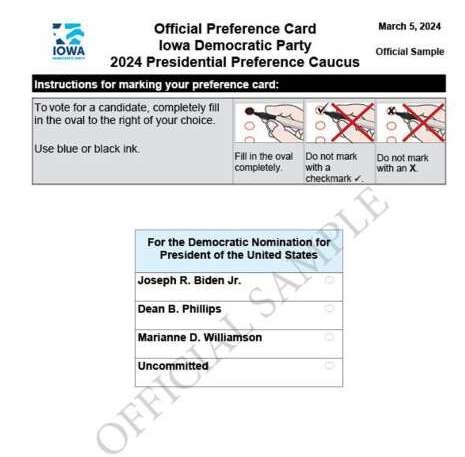
In discussions with New Hampshire, IDP learned that the word “ballot,” and especially the process of qualifying for a ballot, were key elements of what the New Hampshire Secretary of state considered the difference between a “caucus” and an “election.” So IDP came up with the term “presidential preference card” (NOT a “ballot”) and made them all write-in (thus there was no process to qualify).

In this cycle, with Iowa Democrats officially scheduled after New Hampshire, we should no longer care if the term “ballot” triggers them. A little common-sense language would have gone a long way toward convincing critics that IDP really is committed to a new post-First era.

Yet IDP insisted on calling something that any reasonable person would call a “ballot” a “preference card” instead, and called their mail-in voting process a “caucus.” That sent the message that they consider 2024 a temporary setback and that the “natural order” will be restored in 2028. At least this time they put candidates’ names on the “preference cards.”

The media was part of the problem.

With few exceptions, state journalists uncritically parroted IDP’s Newspeak terms “preference card” and “mail in caucus” in the few stories that publicized the process.

Granted, process stories aren’t as fun as chasing candidates. The state press and IDP could do little about the fact that Biden was not going to actively campaign here. In 2012, Barack Obama wasn’t here much either—but he had a large campaign presence in Iowa, which was still a swing state. In 2024, Iowa is about electoral vote 420 on Biden’s depth chart.

So there wasn’t much Democratic news to report. But the stories that did run tended to be too late and too vague—“Deadline to request preference card is today” was a typical story. Confused voters would call their auditor the next day (as the deadline fell on President’s Day) only to be told it was too late and there was no way to vote in person. And when the “preference cards due today” stories landed, auditor staffers like me had to field phone calls from voters standing outside their polling places wondering why they weren’t open.

It didn’t help that there was publicity, including two tweets from Vice President Kamala Harris’s account, listing Iowa as a Super Tuesday state and urging people to go out and vote.

The party needs a better publicity plan.

This may be the most realistic place to expect improvement.

If we will be stuck with this hybrid process for the future, which seems likely, Iowa Democrats need to find better ways to get the word out and boost turnout. The public expectation—a mass mailing to all registered Democrats—is too expensive for a financially challenged party. But the online request process required voters to already be kind of in the know about the inner workings of the party, and confused many older voters. And, again, there was no confirmation email to indicate the request had been successfully completed.

Maybe a contested nomination process will take care of the publicity. We will never again see the kind of candidate resources we saw back in the days of First, but even as a Super Tuesday state we’ll see more than the nothing we saw this cycle.

Democratic legislators need to introduce a primary bill.

The lack of a primary bill makes it look like Iowa Democrats are more committed to the donor class (who feel they have a constitutional right to personal phone calls from presidential candidates) than to our role as the party of voter rights.

We are past the “funnel” deadline for the 2024 legislative session, but there is still time to offer amendments, and there are still election bills pending. I know it won’t pass, and there are of course many other priorities this session. Yet legislators had time this week to introduce two dozen troll amendments to the Don’t Tread On Me license plate bill.

A primary bill is still valuable for the purposes of discussion, and to show national critics that Iowa Democrats are committed to change. The sooner the Iowa Democratic Party truly lets go of its early state fantasies, the sooner we can start undoing the damage Republicans are inflicting on our state.

Saturday, October 07, 2023

Ten months of denial and secrecy over

(Originally published at Bleeding Heartland)

"The Iowa Democratic Caucuses As We Knew Them Are Finally Dead," reads the Friday headline at New York

The truth is, The Iowa Democratic Caucuses As We Knew Them died on December 1, 2022. That night the incumbent Democratic President of the United States said "Our party should no longer allow caucuses as part of our nominating process," and announced a calendar of five early states that did not include Iowa - a decision quickly ratified by the Democratic National Committee's Rules and Bylaws Committee.

What followed was ten months of denial and secrecy by the Iowa Democratic Party which finally ended Friday with an announcement that the party would release the results of the "mail-in caucus presidential preference" on March 5, Super Tuesday, the earliest date allowed by the DNC.

And after all that delay, the final plan looks a lot like what I recommended on December 10: hold the caucus meeting on the same night as the Republicans (which turned out to be January 15, 2024) but only conduct the legally required business of electing precinct level officers and uncommitted delegates. Then after the caucus, at a later date that was compliant with the DNC calendar, we could conduct the mail-in presidential vote.

That's exactly what IDP is going to do, according to an email sent to "SCC Members, Leaders, and Friends" just three minutes before the Friday press conference, which is basically no different that reading it in the Des Moines Register.

What took so long? No one really knows, because IDP leadership was very tight-lipped about the "vigorous and lengthy negotiations with the DNC" from December till this week. Rank and file Democrats deserve to know the details of that. I have a strong opinion but no evidence. Let's just say I think Georgia removing itself from an early Democratic state slot scheduled for February 13 or 20, because Georgia Republicans would not cooperate, was a key factor in the delay.

The entire process was too closed, too secretive, and too long. We should have been discussing how the 2024 process could and should work, in public, way back last winter, with Iowans and not with national committee members, and made the announcement in spring or early summer. That would have set expectations and reduced confusion.

The delay also made it impossible for President Biden and his supporters to start planning for the fall 2024 campaign, because of extremely strict rules against campaigning in non-calendar compliant states. We had to watch fringe candidates Marianne Williamson and Robert F. Kennedy Jr., chaos agents who could care less about rules, speak unanswered at the Iowa State Fair and get free media, while local activists had to worry about whether we were allowed to dust off an old Biden-Harris 2020 sign for a parade - all because IDP refused to set a contest date.

One thing we do know, from the last minute message to the grassroots leaders, is that IDP is playing for the future. "A fight right now over the early state calendar only weakens Iowa Democrats’ future chances," said IDP Chair Rita Hart. "I have repeated reassurance from the Rules and Bylaws Committee and its co-chairs that the presidential nominating calendar discussions will once again be opened up for 2028."

DNC Member Scott Brennan is more direct: "We intend to be first in 2028." Slow down, Scott.

True, Hart and Brennan recognize an important reality: 2024 doesn't matter. It matters even less now that Kennedy is taking his ball and going home for an independent campaign. And there is a certain benefit to Iowa's somewhat cooperative approach to the DNC, as opposed to New Hampshire's defiant insistence that they will break the calendar to stay First. (If they follow through, their delegation could and should not be seated at the national convention at all.)

But this Play For 2028 approach is one more sign of denial. Treating 2024 as a temporary setback means we won't be focused on building an Iowa Democratic Party for a post-First future. We'll still be counting on the national campaigns, organizers and money to come in and do it for us, like they have for the last 50 years - just not this one cycle. And we'll be spending 2025 and 2026 distracted by the Rules And Bylaws Committee again, just like we spent 2022 and 2023.

As for this year, the Iowa Democratic Party is preparing to spend a lot of money which could be used for more important things in order to conduct a pointless vote in an uncontested renomination race, simply to prove that we have learned how to count votes after our problems in 2016 and 2020, in the hopes that if we succeed, all will be forgiven and we will be restored to our "rightful" place on the calendar. We have county auditors who can count votes, at taxpayer expense, but more on that later.

The reality is, there are no "Iowa Democrats' future chances." The whole point of the DNC calendar reform was to get rid of Iowa (and take New Hampshire down a notch). They didn't like our process, they didn't like our demographics, they didn't like our recent election results, and they didn't like our arrogant attitude that First was our birthright.  

Four more years won't make us significantly less of a red state - rebuilding will take Iowa Democrats much longer than two cycles. It won't make us any less old or any less white or any less rural. And exile from the early states for one meaningless re-election cycle won't be enough punishment for a lot of corners of the party. Maybe we'll get some other small token of appreciation for behaving better than New Hampshire, but Iowa doesn't deserve to be considered for an early state slot until we get a state-run primary and until we win some elections.

For now, I need to be just a little positive and look at some details. The timeline announced Friday is as follows:

  • Iowa Democrats will be able to request a presidential preference card (sic) starting November 1, 2023.
  • Presidential preference cards (sic) will be mailed starting January 12, 2024.
  • Iowa Democrats will hold our in-person caucuses January 15, 2024.
  • The last day to request a presidential preference card (sic) is February 19, 2024.
  • The Iowa Democratic Party will release results of our 2024 mail-in caucus presidential preference (sic) on March 5, 2024.
  • Iowa Democrats will accept presidential preference cards (sic) postmarked on or before March 5, 2024.

First of all, let's use honest language. Now that we don't have to play word games with the New Hampshire Secretary of State, let's drop the stupid and confusing term "presidential preference card." It's a ballot. And it's not a "mail-in caucus presidential preference" - it's a party-run primary.

The first ballot request date, November 1, is really, really soon. It's still not clear what form those requests will take. If they're on line, accommodation will need to be made for those without computers. If they're paper, they'll need to be distributed somehow. And there are many people who will only be able to get a request form if someone prints it and mails it to them, which is an expense. Who does that - the state party or the locals?

Ballots will be mailed January 12. There is a five week overlap period when requests will be coming in and ballots will be both be coming in and going out. This overlap period includes Caucus Night. That means some people will come to the caucus with their ballots in hand and will want to turn them in. I would also expect IDP to include ballot requests in the caucus materials. That's a lot of stuff to juggle for a volunteer caucus chair and there's a risk of ballots getting misplaced. It might be better to hold off on mailing the ballots just four days, until after the caucus.

That said, many people will not trust the post office with a ballot and will want to return it in person. In earlier versions of the plan, IDP talked about county drop boxes. How will county parties be expected to manage and safeguard that? The average county chair does not have a box that's built like a tank and a 24 hour security camera like an auditor does.

The party plans to both announce results on March 5 and accept ballots postmarked March 5. That's going to mean a second set of results after caucus night to include the late arrivals. I think this is a rhetorical point. IDP wants to complain about the recent Republican driven change in state law that requires ballots to arrive before polls close on Election Day. Fine - but we'll need to set some specified cut-off date.

As for March 5, I was hoping for a different date. Iowa's results will be buried in the flood of results from both parties in other Super Tuesday states (to the extent that anyone cares about Biden 98%, Williamson 2% results). I would have preferred county convention day, March 23. This would have been a fun news handle for the county conventions (to the extent that anyone cares about Biden 98%, Williamson 2% results). But, as I expected, IDP clearly decided that the important thing was to go as soon as possible to emphasize that we really, really want to be an early state again.

Not discussed in the party release: Whether or not names will be printed on the ballots, and if so, the process to qualify. Will they be machine countable, which is way more accurate than a hand count? If not, are we going to quibble about whether "Joe" or "Biden-Harris" or "Bidin" votes will count?

So there's a lot more details to be fleshed out, and that will need to happen in less than four weeks before those requests start coming in.

In the big picture, there is good news. The most important change happened months ago, even before Iowa Democrats were demoted in the calendar. The old system where people had to stand in the corner for hours of endless headcounts and realignments, in crowds of up to 900 people, is over. Anyone who simply wants to vote for president does not need to attend a meeting at one and only one specific time and place. Since Iowa Republicans will not cooperate with an auditor-run primary election, a mail-in party run primary is as good as Democrats can do. The party of voting rights needs to contrast our improved, inclusive system with the same as it ever was Republican caucus where if you cannot attend, you cannot vote. And we should push for more.

The next legislative session starts very close to caucus night. Democratic legislators should emphasize voting rights by introducing a bill for a real, auditor-run Iowa presidential primary. It doesn't matter that Republicans won't assign it to a committee. It's a point that should be made and it's a point that will make national news. And, if you think trying to get back into the early states is important, it's a point that will help our standing with the rest of the national Democratic Party.

Thursday, July 13, 2023

Thoughts on Running for Office

In the wake of the special session there's been a lot of Run For Something talk. I've been that person who ran and lost a tough race no one else wanted to run. It's been a while but the fundamentals haven't changed much. I don't want to throw water on anyone or be a gatekeeper. I just have experience and advice. Some of it's hard. You can accept or reject as you like (remember, I lost)

I’m not going to talk about ideology - reasonable people disagree on the best approach - or biography – you are who you are. I’m talking about universal constants.

First off: You will probably lose. You need to be OK with that. There are a LOT of reasons to run besides winning yourself. If you can move the needle for the top of the ticket a few points in your direction, you've accomplished something and you've built for the future.

But running might not be the best thing for you, and it may be bad enough that it's better if nobody runs. Google yourself. If the first thing you find is damaging or embarrassing, know that the other side will use not only against you but against the rest of the ticket. We dodged a bullet last cycle in one area district.

Look at every social media account you've ever had all the way back to MySpace and Friendster and be prepared to answer for anything you ever posted. If you can find it, they WILL find it.

You will have to raise money. "If every Democrat in my district donates $5" is not a plan. Even if you can name the rare counter example, Magic Internet Money is not a plan. "The state party will pay for it" is not a plan. This doesn't mean "the party doesn't care about rural districts." But at some point they have to look at numbers and odds. What limited resources they have will be spent on the swing districts. Triage is cold and cruel and you will probably be triaged out like I was.

The deal is: You, personally, will have to cold call people and ask for money, starting with family, friends, and working out to party donors. You will hate this. Everyone from Joe Biden on down hates this. It's the only way.

"Money isn't the only thing." True. But without it nothing else happens. Volunteers are great but they need lit to drop, signs to put up, and something to stuff envelopes with. That's not free. You don't have to match your opponent dollar for dollar. But you have to have enough cash to be visible and credible.

"If every independent votes for me, I'll win" is not winning math. That's drawing to an inside straight. Unaffillated voters vote pretty much the same way as their neighbors who register with a party. Again, you personally winning is not the only big picture goal.

"I'll talk about the issues." You're already an idealist for taking on this tough race, and that's good.  That's how it's supposed to be. That's not how it is.  Your small campaign will not be able to change this.

How long have you lived in your town and been active in the community? Do people know your family? In a lot of districts this matters more than "issues." I ran a year after I moved into the district and I was VERY clearly an outsider. I was a terrible fit, but it was me or no one.

How's your job? Can you afford, professionally or economically, to take time away from work - vacation days, an unpaid leave of absence? Would you even be allowed to do that? (Yes, you have some rights, but good luck with that.) It's not fair that people who are financially better off have an advantage in politics - but it's that way with EVERYTHING.

All those tough things said, my people in the district were very grateful I did what I did, and I'm proud of it. It was a learning experience that made me better able to help other candidates. I like to think my little campaign helped Bill Clinton and Tom Harkin win Louisa County. I made some long term friends. And some of the people who helped me  went on to bigger and better things.

I'll end on a couple positive recommendations.

You should spend as much of your time as possible doing the things that only you can do. That means talking to voters and it means the lion's share of the money asking. It also means your Human Being Stuff - being a partner/parent/adult child, your day job, and your other personal stuff that can't be delegated. But everything, on the campaign side and personal side, should be delegated when possible. Candidate spouses are the real heroes.

Finally, be yourself. Not everybody is going to like you. But everyone hates a phony.

Sunday, June 04, 2023

Billboard chart rules and eras

You can't compare any Billboard chart records pre-1991 to post-1991 or pre-1999 to post-1999 because of the way marketing and chart rules have changed.

There's six distinct Billboard chart eras:

Pre-Hot 100 - multiple singles charts for airplay, sales and jukeboxes, often with different Number 1s at once. Pre-rock transitioning to rock (peak Elvis is pre-Hot 100). Long peaks, especially for non-rock songs. Multiple versions of the same song often chart simultaneously (the good original version and the lame Pat Boone cover).

The pre-Hot 100 "Top 100" was dated on Wednesday from 11/2/55 through 6/19/57.

There was a three day "week" with the chart date moving to Saturday on 6/22/57. It stayed Saturday until 7/19/58, the last Top 100.

There was no chart Sat 7/26/58 or Mon 7/28/58.

1958-late 70s - Hot 100 comprehensive chart debuts Monday 8/4/58. It was a Monday date through 12/25/61. It's not entirely clear whether there was a Saturday 12/30/61 chart. If you click on that date on the Billboard website it gives you the 1/6/62 chart. However, some sources list unique data for a 12/30/61 chart. In any case, this was the point of transition from a Monday chart date to the Saturday chart date, where it has remained since.

Data was self-reported by stores and stations, often manipulated (payola). Single release required for Hot 100 eligibility. Some famous album cuts (Stairway To Heaven) ineligible.

Glory days of Top 40 radio. Rapid chart turnover. Short songs, with a norm of 3 minutes, though this grows steadily with time (landmarks: Like A Rolling Stone, Hey Jude. Elton John's singles regularly exceeded 5 minutes.) Albums become important mid to late 60s (Sgt. Pepper). Record sales grow throughout the period. Artists released an album or two (Beatles, Elton John) per year, but usually only one to three singles per album. One off non-album singles are common.

Long chart peaks (I Want To Hold Your Hand 7 weeks at Number 1, Hey Jude 9) fade away around 1970, and vanish by 1976. In 1974-75 one week at Number 1 was the norm and four weeks would get you Number 1 for the year. Chart runs over 20 weeks are rare.

The All Beatle Top Five was a unique anomaly driven by America's delayed case of Beatlemania; rights to the early material were split among multiple labels. Once the early material had all been released in America, this didn't happen again. For my money, given the differences in rules and patterns over the years, the All Beatle Top Five remains the greatest chart achievement.

Another major chart outlier in this era is The Twist due to its two Number 1 chart runs 18 months apart. Until very recently The Twist was called "the biggest hit of all time" (again my whole point is that comparing across eras is impossible).

Late 70s - November 1991- Same chart rules, but different patterns due to different record release strategies. Top 40 Radio fragments and loses its cultural dominance to MTV. Long chart peaks briefly return 1977-82 (You Light Up My Life and Physical 10 weeks, see also Night Fever, Endless Love, I Love Rock & Roll) but vanish by the mid-80s (When Doves Cry at 5 weeks in `84 was about as long as it got - unfortunately for Bruce Springsteen who was stuck at 2 and never did get a Number 1).

Songs start to get longer with the average closer to four minutes; the Casey Kasem countdown expanded from three hours to four. 

Record sales plummet fast in the fall of 1978 (notorious flops: Sgt. Pepper Soundtrack, the Kiss solo albums). Albums become more important than singles and cassettes start to take over from vinyl (with CDs emerging late in the era). Sales grow back as the formats change.

Chart runs for singles get a little longer (Tainted Love sets a record at 43 weeks) but rarely get beyond six months. What happens instead:

The Long Album Cycle begins, with acts releasing four (Rumours), five (Purple Rain, Sports, Heartbeat City), or even seven (Born In The USA, Thriller, Rhythm Nation) singles from an album over cycles lasting up to two years. Non-album singles become rare. Still some unity to pop culture (Thriller), with Nirvana being the last mass culture moment. 

From 1976 to 1991 the chart was "frozen" over the holiday week. This does not mean "Let It Go" was Number One. The end of the year issue was a double issue focused on year end charts and Billboard skipped a publication week. Officially these unpublished magazine weeks are chart dates, but the chart is identical to the prior week (all positions were "frozen"). In most cases the pre-Christmas #1 song held over, but there were exceptions:

1/1/77: Rod Stewart got credit for an 8th week at #1, a LOT for that era, but fell out of #1 on the 1/8 chart. Did he REALLY hold on for an 8th week or would Marilyn McCoo and Billy Davis Jr have knocked him off a week earlier if there had been a fresh chart?

12/30/78: #1 transition the next week, Le Freak to Too Much Heaven

12/29/79: #1 transition the next week, Pina Colada Song to Please Don't Go.

November 1991-December 5, 1998 - The Soundscan Era, the CD era. A transitional era for charts. Direct collection of data begins in November 1991 and chart patterns change immediately - but single release is still required for Hot 100 eligibility. But this is when the vinyl single dies, and CD and cassette singles never sell as well as the glory years of 45s. Thus radio airplay dominates the charts.

The beginning of extreme long chart runs (How Will I Live, You Were Meant For Me at about 15 months each) and long Number 1 peaks (I Will Always Love You and Macarena at 14 weeks, One Sweet Day at 16).

The album and airplay charts were more accurate indicators of real popularity than the Hot 100 as many key hits (Iris, Don't Speak) were not issued as singles in order to to boost CD sales (the "one good song on the CD" era). This contributed to long #1 peaks as the competition was weaker for the songs that WERE chart eligible (Candle In The Wind 1997 and Unbreak My Heart).

High chart debuts begin in 1995. This culminates in the first Number 1 debuts (MJ again with the quickly forgotten You Are Not Alone). Debuts were often manipulated by delaying the limited quantity but chart-required single release until airplay peaked (Sunny Came Home).

Beginning with the weeks of 12/26/92 and 1/2/93 Billboard ended their "holiday freeze" and resumed publishing unique charts over both Christmastime weekends.

December 5, 1998-circa 2010 - Early modern era. Album cuts become chart eligible, and in 2000 Aaliyah earns the first Number 1 single without a single. The iPod and download era (legal and not). With MTV abandoning music videos, and everyone with headphones serving as their own DJ, the mass culture era ends. Still primarily a singles era (begins to change with Taylor Swift's 2008 album Fearless becoming a proto-chart bomb). Number 1 debuts nearly vanish except for American Idol stars.

Several longevity records set, with Black Eyed Peas holding Number 1 for 26 straight weeks.

The 2000s marked the rapid growth of the "Featuring" credit, as collaboration becomes a norm with the singer singing the hook or multiple rappers taking a verse. This skews chart stats a lot, in particular numbers of hits stats.

2010-present - The modern era. Streaming emerges as the primary medium. Number 1 debuts return and become almost the norm. Chart manipulation moves from the payola/false reporting problem of the Classic Hot 100 Era to the fanbase model (bulk purchases, endless loop streaming, etc - Nicki Minaj and KPop fans are particularly rabid at this, though Swifties are not 100% innocent. Many artists play into it). Chart rules frequently change to try to stay one step ahead - see the ban on "bundling" (free single with purchase of tickets or merch).

The "remix" also became a chart factor. This has been around for 20+ years (J Lo's "I'm Real") but in the late 10s and the 20s it's a big chart tactic. 

It's not uncommon for a song to reach Number 1 without having ANY impact on the larger pop culture outside the act's core fanbase (the "stans"). Huge Week 2 drops are common (BTS member Jimin's solo single just dropped from 1-45 for a new record. Nicki Minaj dropped 1-34 and Swift dropped 1-38 though that was mostly due to the Holiday Chart Bomb).

The rare "stable and organic" hits stay at Number 1 for months (Old Town Road a record 19 weeks, As It Was 15, Despacito 16, Uptown Funk 14).

Beginning of the serious Chart Bomb Era where many or even all songs on a superstar album (primarily Swift and Drake, but others like Bad Bunny) debut at once. Compare 26 out of 30 tracks on the Hot 100 for Red TV vs. zero of 30 for the no-single White Album. First the Beatles 14 of Hot 100 record fell. Then Drake tied the All Beatle Top Five. Finally Taylor occupied the entire Top Ten.

Most chart bombs are short as the non-singles ("single" being more a mood than an actual format, signaling radio promo efforts or video releases) drop fast the 2nd week (though the biggest tracks from Swift's latest album have shown some longevity in the low to mid rungs).

A minor variation is the Necro Chart Bomb when an artist dies (Prince, Petty, Bowie) and their greatest hits re-chart for a week.

Starting in the late 2010s there's also a four week or so Holiday Chart Bomb when the same core group of Christmas songs returns each year, breaking lots of chart records related to slow climbs, fast drops, and multiple runs (All I Want For Christmas Is You taking 25 years to hit Number 1, hitting Number 1 in four separate chart runs, and dropping from Number 1 to completely off the chart three times). 

Each year the Holiday Chart Bomb gets bigger and longer. This has the side effect of interrupting otherwise long consecutive chart streaks, as holiday songs push down non-seasonal songs and trigger the Recurrent Rule (dropping below 50 after 20 weeks gets you dropped from the chart) or the Super Recurrent rule (dropping below 25 after a year). It also leads to high re-entries like "Blinding Lights" returning at number 3 the week after Christmas. I'm not at ALL a fan of the Holiday Chart Bomb (for decades Christmas songs were only listed on a special holiday chart - a policy I believe should return).

Chart turnover is low and slow except for weeks with chart bombs. Songs stay on the chart either one week (Glee Cast, chart bombs), exactly 20 or 52 weeks, or forever: 90 weeks, including over a year in the top ten, for the new "biggest hit of all time" Blinding Lights, and 91 weeks for Heat Waves which took 59 weeks to reach Number 1. Songs peak either in Week 1 or in Week 46 or so, with country tracks lingering for months in the low chart rungs and slowly building. 

Some acts accumulate insane numbers of "Featuring" credits (Drake, Minaj, Lil Wayne). In contrast, nearly all of Swift's hits are as a solo artist or in a handful of cases Swift as the lead artist with a guest. However the re-recordings have racked up roughly 40 duplicate hits ("You Belong With Me" and "You Belong With Me Taylor's Version" are considered separate chart entries).

With numbers of streams, and quick hooky viral videos, becoming more important, the average length of hits has dropped back toward the three minute mark. One stream of a song is one stream, whether it's the 1:52 original version of Old Town Road or the 10:13 long version of All Too Well (making Swift's achievement of Number 1, and the longest running time Number 1 ever, all the more impressive).